Finance Bill 2026: Why financial privacy is not a privilege granted by the state
By Cynthia Lodite, May 24, 2026Constitutional lawyer Willis Evans Otieno has strongly criticised proposals in the Finance Bill 2026, arguing that they risk normalising state surveillance and eroding Kenyans’ fundamental right to financial privacy.
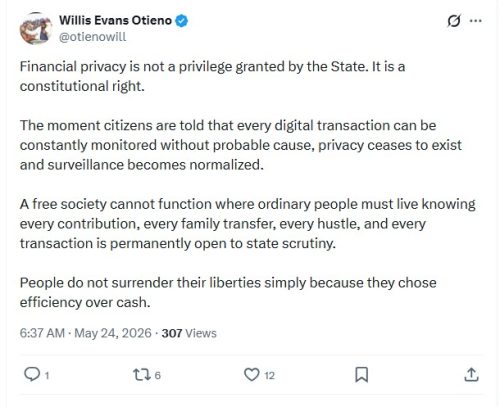
In a statement on his official X account on Sunday, May 24, 2026, the renowned lawyer warned that financial privacy is not a privilege granted by the state but a constitutional right.
His remarks come against the backdrop of proposed tax measures in the Finance Bill 2026 to impose value-added tax on digital payment platforms.
He warned that requiring constant monitoring of digital transactions without probable cause would fundamentally undermine the constitutional right to privacy.
“The moment citizens are told that every digital transaction can be constantly monitored without probable cause, privacy ceases to exist and surveillance becomes normalised,” Otieno stated.
What does Article 31 say?
Article 31 of the Constitution states that “Every person has the right to privacy,” which includes the right not to have their person, home or property searched; their possessions seized; information relating to their family or private affairs unnecessarily required or revealed; or the privacy of their communications infringed.”
With the guidance of Article 31, financial records, transaction histories, wallet activities, and related data qualify as “information relating to… private affairs.”
Meanwhile, financial privacy is constitutionally protected in Kenya as an aspect of the broader right to privacy, reinforced by data protection laws.
However, it involves ongoing tensions with regulatory needs and specific policies like those in the Finance Bill 2026.
Worth noting, the proposed tax measure in the Finance Bill 2026 includes amendments to the Tax Procedures Act that would compel these platforms to file annual information returns with the Kenya Revenue Authority (KRA).
The returns would then disclose customer identities, full transaction histories, wallet activities, purchase prices, sales values, and profits for Kenyan users.
“A proprietary digital platform, payment network. payment-card scheme, payment processing system, switching system, clearing system or settlement system, including access, participation or usage rights in such system through a card, whether the consideration is periodic or transaction-based and whether or not the payment is described as a service fee, transaction fee, network fee, assessment fee, processing fee or similar charge,” Finance Bill 2026 reads in part.