FAO report explains why healthy food remains so expensive for many Kenyans today
By Aloys Michael, July 25, 2026For many Kenyan families, buying maize flour for ugali is manageable, but adding eggs, milk, fish, fruits and vegetables to the shopping basket often doubles the grocery bill. A new report by the Food and Agriculture Organisation (FAO) explains why healthy food remains significantly more expensive than calorie-rich staple foods.
The report, The State of Food Security and Nutrition in the World 2026, published jointly by the FAO, International Fund for Agricultural Development (IFAD), UNICEF, World Food Programme (WFP) and the World Health Organisation (WHO), concludes that healthy diets remain economically out of reach for large segments of the global population, despite improvements in food security since the COVID-19 pandemic.
“Healthy diets are essential to achieving Sustainable Development Goal 2, but remain economically out of reach for large segments of the global population,” the report says.
The findings help answer one of the most common questions Kenyan consumers ask: Why is healthy food so expensive in Kenya?
Why healthy food prices in Kenya remain high
According to the FAO report, the highest cost of eating healthily is not staple foods such as maize, rice or wheat. Instead, the most nutritious foods, including eggs, milk, meat, fish, fruits and vegetables, account for almost 70 per cent of the total cost of a healthy diet, while starchy staples contribute only a small fraction of the overall cost despite providing about half of daily calorie requirements.
This explains why many households can afford foods that fill the stomach but struggle to buy enough nutrient-rich foods needed for a balanced diet.
For families searching online about the cost of healthy eating in Kenya, the report suggests that the challenge is structural rather than simply a result of temporary price increases.
Consumers often assume farmers receive most of the money paid for fresh produce. However, the FAO report says the majority of food costs are added after products leave the farm.
Processing, transportation, storage, wholesale distribution and retail account for around 70 to 75 per cent of the final price consumers pay for many foods.

Fresh fruits and vegetables are particularly affected because they spoil quickly and require efficient roads, refrigerated transport and cold storage before reaching supermarkets and local markets.
This helps explain why vegetables cost more in Kenya, especially during dry seasons or when transport costs rise.
Food inflation is only part of the problem
Although food inflation in Kenya often attracts headlines, the FAO says higher prices are only one part of a broader challenge.
The report identifies poor transport infrastructure, inefficient logistics, limited cold-chain systems, high production costs and weak market integration as major factors pushing up the price of healthy foods.
It says investments in agricultural research, better rural roads, improved transport networks, lower input costs and stronger regional trade can make nutritious foods more affordable over time.
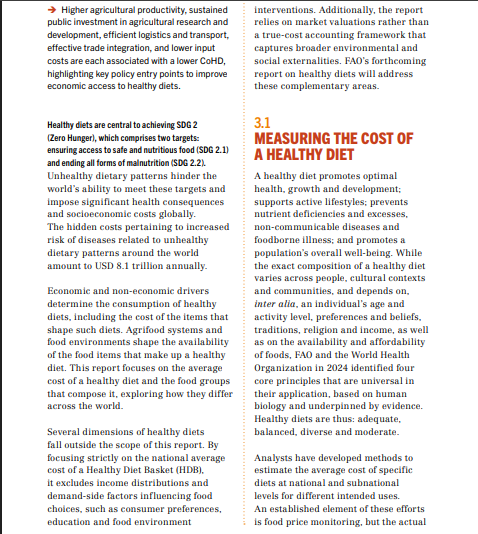
“Higher agricultural productivity, sustained public investment in agricultural research and development, efficient logistics and transport, effective trade integration, and lower input costs are each associated with a lower cost of a healthy diet,” the report says.
Is healthy eating only for wealthy households?
The report does not suggest that healthy eating should be reserved for wealthier families. Instead, it argues that governments can reduce costs by making nutritious foods easier and cheaper to produce, transport and sell.
It also notes that using locally available, lower-cost foods can substantially reduce the cost of a healthy diet, particularly in countries with greater diversity of fruits and vegetables.
For Kenyans looking for healthy eating on a budget, this means choosing affordable local produce whenever possible while broader investments improve food supply chains.
The FAO concludes that making healthy diets affordable will require more than increasing food production. Improving roads, storage facilities, transport systems and agricultural productivity will be just as important in lowering grocery bills.
For households wondering why healthy food is so expensive in Kenya, the report offers a clear answer: the price of nutritious food reflects not only what happens on the farm but also the high cost of moving, preserving and delivering it efficiently to consumers.