Advertisement
Equity and bond markets hit by rising inflation and Middle East tensions
Saturday 07th March, 2026 08:47 AM|

Global financial markets faced renewed pressure this week as escalating conflict in the Middle East drove sharp increases in oil prices. Investors reacted with caution amid growing inflation concerns and heightened risk aversion.
The intensification of strikes and retaliatory actions around the Strait of Hormuz, a key transit point for roughly 20 per cent of global oil and LNG flows, disrupted shipping and added uncertainty to energy markets.
“International oil prices increased during the week, reflecting the escalation of the Middle East conflict, which disrupted supply chains. Murban crude oil traded at USD 76.25 per barrel on March 5, compared to USD 69.73 per barrel on February 26,” the CBK bulletin dated March 6, 2026, reads in part.
Nairobi Securities Exchange dips
The Nairobi Securities Exchange reflected this volatility during the week ending March 5, 2026. Key indices declined sharply, with the NASI falling 3.69 per cent, the NSE 25 dropping 2.84 per cent, and the NSE 20 decreasing 2.96 per cent.
You Might Also Like



Market capitalisation contracted by 3.69 per cent, total shares traded fell 29.06 per cent, and equity turnover slipped 19.57 per cent. These movements came after a strong rebound the previous week, highlighting how quickly investor sentiment shifted amid geopolitical shocks.
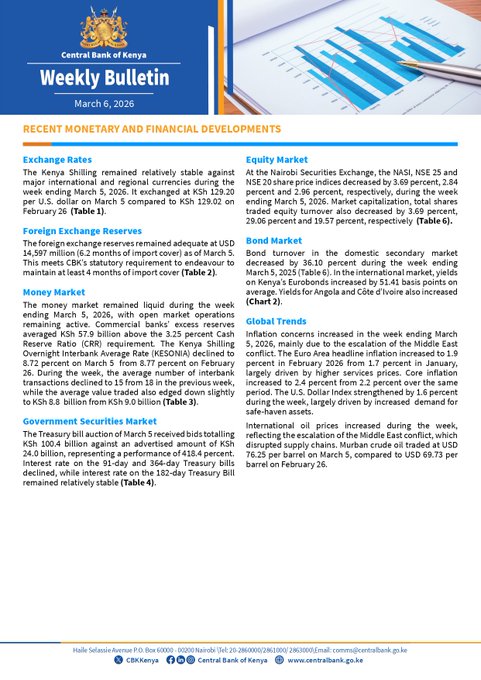
“At the Nairobi Securities Exchange, the NASI, NSE 25 and NSE 20 share price indices decreased by 3.69 per cent, 2.84 percent and 2.96 per cent, respectively, during the week ending March 5, 2026. Market capitalisation, total shares traded, and equity turnover also decreased by 3.69 per cent, 29.06 percent and 19.57 per cent, respectively.”
Bond yields rise amid higher oil prices
In the bond market, domestic secondary market turnover fell 36.10 per cent, while Kenya’s Eurobond yields rose by an average of 51.41 basis points. Similar yield increases were reported in Angola and Côte d’Ivoire.
The surge in oil prices from USD 69.73 per barrel on February 26 to USD 76.25 by March 5 intensified concerns about imported inflation. Globally, Euro Area headline inflation increased to 1.9 per cent in February from 1.7 per cent, with core inflation rising to 2.4 per cent.
The U.S. Dollar Index strengthened by 1.6 per cent as investors sought safe-haven assets.
InKenya, the shilling remained steady at Ksh 129.20 per US dollar, supported by foreign reserves of Ksh1.886 trillion, equivalent to 6.2 months of import cover. The money market remained liquid, with the Kenya Shilling Overnight Interbank Average Rate easing slightly to 8.72 per cent. While domestic inflation remains contained at 4.3 per cent, imported pressures from rising global oil prices could affect the economy if tensions persist.
Investors continue to monitor developments closely, with markets sensitive to supply disruptions and further escalation in the Middle East. Sustained high oil prices could influence monetary policy, affect borrowing costs, and shape confidence in Kenya’s financial assets.
Author
Latest News








Advertisement
More on Business