Advertisement
NSE equities rise as global markets remain cautious
Saturday 31st January, 2026 07:30 AM|

Equities at the Nairobi Securities Exchange (NSE) recorded gains during the week ending January 29, 2026, even as global markets remained cautious amid geopolitical risks and steady monetary policy stances by major central banks.
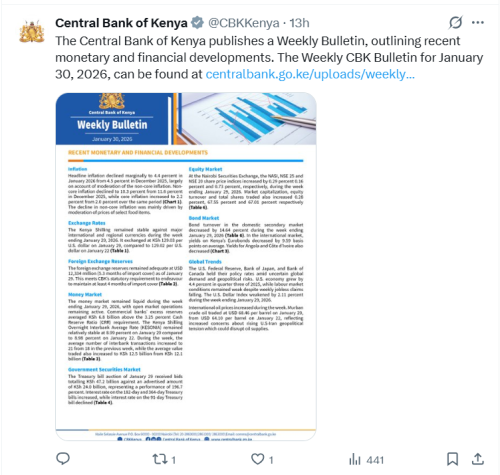
According to the Central Bank of Kenya (CBK) weekly update, “At the Nairobi Securities Exchange, the NASI, NSE 25 and NSE 20 share price indices increased by 0.29 percent, 0.16 percent and 0.73 percent, respectively, during the week ending January 29, 2026.”
The improved performance reflected increased trading activity and sustained investor participation.
The CBK reported that the market capitalisation, equity turnover, and total shares traded also increased 0.28 percent, 67.55 percent and 67.01 percent respectively.
You Might Also Like


“Market capitalisation, equity turnover and total shares traded also increased 0.28 percent, 67.55 percent and 67.01 percent respectively.” The surge in equity turnover and volumes signalled heightened activity at the bourse, with investors actively repositioning across counters during the review period.
Equity market performance
The gains at the NSE came against a backdrop of mixed global signals, with investors balancing local market opportunities against external uncertainties. The rise in share price indices was accompanied by a notable increase in the value and number of shares traded, indicating stronger engagement across the market.
The CBK noted that money market conditions remained supportive during the week, helping sustain liquidity in the financial system. This environment contributed to steady participation in the equities segment, even as broader global sentiment remained cautious.
Bond market and Eurobonds
Activity in the domestic bond market softened during the same period. The CBK reported that bond turnover in the secondary market declined by 14.64 percent in the week ending January 29, 2026.
In contrast, Kenya’s performance in the international debt market improved, with yields on the country’s Eurobonds declining by an average of 9.59 basis points. Similar yield declines were observed for Angola and Côte d’Ivoire, reflecting improved sentiment toward selected African sovereign debt instruments during the week.
Global developments and oil prices
On the global front, the CBK stated that “The U.S. Federal Reserve, Bank of Japan, and Bank of Canada held their policy rates amid uncertain global demand and geopolitical risks.”
The U.S. economy recorded growth of 4.4 percent in the third quarter of 2025, although labour market conditions remained weak despite a fall in weekly jobless claims.
The U.S. Dollar Index weakened by 2.11 percent during the week under review. At the same time, international oil prices rose, with Murban crude oil trading at USD 68.46 per barrel on January 29, up from USD 64.10 per barrel a week earlier.
The CBK attributed the increase to “increased concerns about rising U.S-Iran geopolitical tension which could disrupt oil supplies.”
Overall, the NSE’s positive performance contrasted with a cautious global outlook shaped by geopolitical tensions, stable interest rates, and volatility in energy markets.
Author
Latest News






Advertisement
More on Business