Advertisement
EPRA reduces fuel prices in January- February cycle
Wednesday 14th January, 2026 08:21 PM|

The Energy and Petroleum Regulatory Authority (EPRA) has announced a reduction in fuel prices for the January–February pricing cycle, offering some relief to motorists and households across the country.
The new prices will apply nationwide from January 15, 2026, to February 14, 2026, following EPRA’s latest monthly review.
Prices of Super Petrol, Diesel and Kerosene have decreased by Ksh2.00, Ksh1.00 and Ksh1.00 per litre respectively.
Following EPRA’s review in Nairobi, Super Petrol, Diesel and Kerosene now retail at Ksh182.52, Ksh170.47 and Ksh153.78, respectively, effective midnight for the next 30 days.
You Might Also Like



“The prices are inclusive of the 16 per cent Value Added Tax (VAT) in line with the provisions of the Finance Act 2023, the Tax Laws (Amendment) Act 2024 and the revised rates for excise duty adjusted for inflation as per Legal Notice No. 194 of 2020,” EPRA’s statement read in part.

The announcement was made on Wednesday, January 14, 2026, through a statement posted on the regulator’s official X account, outlining what is driving the changes and how long they will last.
“In accordance with Section 101(y) of the Petroleum Act 2019 and Legal Notice No.192 of 2022, the Energy & Petroleum Regulatory Authority (EPRA) has calculated the maximum retail prices of petroleum products which will be in force from January 15, 2026, to February 14, 2026,” the statement reads.
EPRA explained that all three major fuel products will now cost less at the pump compared to the previous cycle, with different reductions applied to each product.
“In the period under review, the maximum allowed petroleum pump prices for Super Petrol, Diesel and Kerosene decreased by KShs.2.00/litre, KShs.1.00/litre and KShs.1.00/litre respectively,” the statement reads.
The authority also clarified that the announced prices already factor in all applicable taxes, including value-added tax and excise duty adjustments.
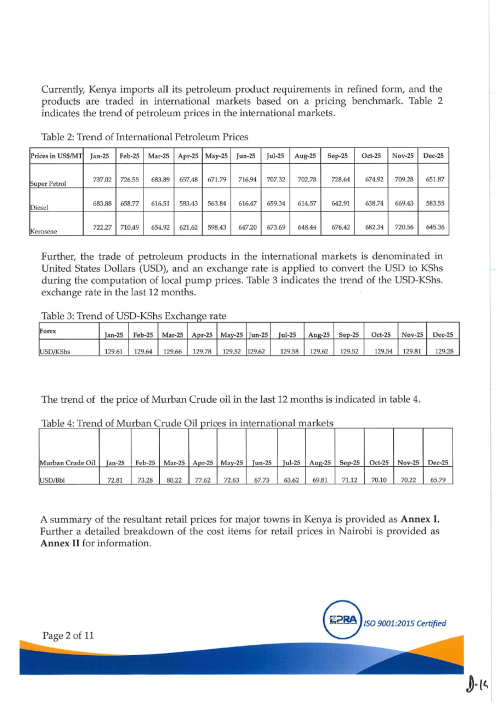
Importing cost
According to EPRA, the drop in pump prices is closely linked to changes in the cost of importing fuel into the country over the past two months.
“The average landed cost of imported Super Petrol decreased by 0.10 per cent from US$592.84 per cubic metre in November 2025 to US$592.24 per cubic metre in December 2025; Diesel decreased by 4.20 per cent from US$654.24 per cubic metre to US$626.75 per cubic metre while Kerosene decreased by 8.92 per cent from US$667.05 per cubic metre to US$607.55 per cubic metre over the same period,” EPRA explained.
EPRA further noted that Kenya continues to rely entirely on imported refined petroleum products, which exposes local fuel prices to movements in global markets and currency exchange rates.
“Currently, Kenya imports all its petroleum product requirements in refined form, and the products are traded in international markets based on a pricing benchmark,” the statement reads.
The regulator added that fuel trade is done in US dollars, meaning movements in the shilling against the dollar also play a role in how pump prices are set locally.
“Further, the trade of petroleum products in the international markets is denominated in United States Dollars (USD), and an exchange rate is applied to convert the USD to KShs during the computation of local pump prices,” the statement reads.
Author
Latest News





Advertisement
More on Business