Advertisement
CS Kagwe urges end to Kenya’s egg imports, now at 5B annually
Saturday 25th October, 2025 02:39 PM|

Kenya imports about five billion eggs every year to meet national demand, a situation Agriculture and Livestock Development Cabinet Secretary Mutahi Kagwe says is unsustainable and must stop.
Kagwe said Kenya currently produces around four billion eggs annually against a national demand of nine billion, creating a deficit of five billion eggs that are imported each year. He said the country must increase local production to achieve food security and protect farmers.
“We must stop importing eggs and start producing enough for ourselves. That requires farming guided by science,” Kagwe said.
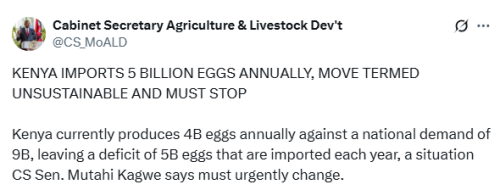
According to a post made by the Ministry of Agriculture on X on Saturday, October 25, 2025, Kagwe made the remarks during a visit to the Kenya Agricultural and Livestock Research Organisation (KALRO) Msabaha Research Centre in Kilifi County, where he emphasised the need for research, data, and science-based agricultural practices.
You Might Also Like

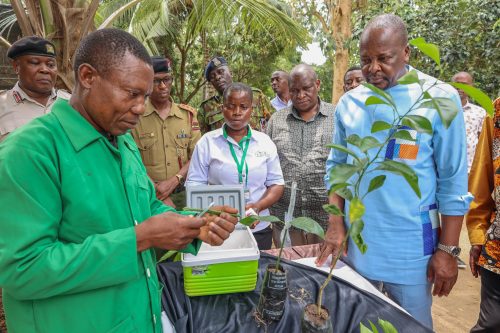
During his tour, Kagwe observed ongoing research at the centre, including grafting of improved crop varieties and the formulation of nutritious livestock feeds. He said such innovations are key to improving productivity and building resilience in Kenya’s agricultural sector.
The CS also noted that with a growing population and limited land, soil testing, proper input use, and precision agriculture are critical for increased yields.
Youth, quality drive agriculture
The Cabinet Secretary noted the ministry’s focus on promoting quality-based milk production through improved animal breeds and better husbandry practices. He said improving the quality and efficiency of livestock production will help farmers earn more and meet domestic demand.
Kagwe further urged young people to take up farming, pointing out that the average age of a Kenyan farmer is 64 years. He said the ageing farming population poses a risk to the country’s food production goals. He said that agriculture should not be viewed as a last resort but as a viable business.
“Our young people understand technology. Let’s pass the torch to them — they are the future of modern, scientific agriculture,” he said.
Kagwe said his ministry will continue to work closely with research institutions like KALRO to develop improved crop varieties, better livestock feeds, and farming methods suited to Kenya’s environment.
Author
Kenneth Mwenda
Kenneth Mwenda is a business, sports, and politics digital writer with over seven years of experience in journalism, covering breaking news, feature stories, and in-depth analysis across a range of beats.
For inquiries, he can be reached at [email protected]
View all posts by Kenneth MwendaLatest News






Advertisement
More on Business