Advertisement
Controller of Budget report reveals State House spent Ksh4.45B outside approved budget
Thursday 11th June, 2026 08:19 AM|

The Office of the Controller of Budget has revealed that State House accessed and spent an additional Ksh4.45 billion that was not included in the original parliamentary allocation for the 2025/26 financial year.
According to the National Government Budget Implementation Review Report for the first nine months of FY 2025/26 (ending March 2026), State House recorded significant over-expenditure under its Coordination of State House Functions programme.
“The over-expenditure on Coordination of State House Functions sub-programme was attributable to additional funding of Kshs4.45 billion under Article 223 of the Constitution in favour of the State House for other operating expenses,” the report states on page 243.
Budget performance overview
State House had the following approved allocations for the financial year:
- Recurrent budget: Ksh7.684 billion
- Development budget: Ksh 894.91 million
- Total approved budget: Ksh8.579 billion
You Might Also Like
However, by March 31, 2026, total recurrent spending had risen to Ksh10.79 billion. This pushed the absorption rate for the Coordination of State House Functions sub-programme to 140 per cent, well above the expected nine-month benchmark.
The additional funding was accessed through Article 223 of the Constitution, which allows the national government to withdraw funds not initially approved by Parliament in cases of emergency or unforeseen need, subject to approval by the Controller of Budget.
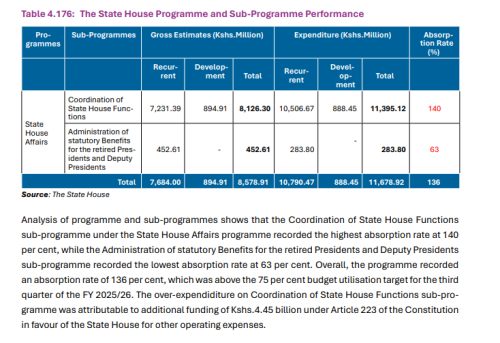
The report shows that the Article 223 funds were mainly used under “other operating expenses”.
As a result, the Coordination of State House Functions programme alone spent Ksh10.51 billion against its original recurrent allocation of Ksh7.23 billion.
Overall, the State House programme recorded a 136 per cent absorption rate for the review period, significantly above the standard benchmark of around 75 per cent for nine months.
Deputy President’s office expenditure
According to Table 2.10 of the report, the Office of the Deputy President also accessed additional funding under Article 223.
The office had:
- Recurrent allocation: Ksh2.97 billion
- Approved Article 223 funding: Ksh1.05 billion
- Actual withdrawals approved: Ksh507.84 million
This represents a partial utilisation of the approved supplementary allocation, reflecting lower-than-requested absorption compared to some other agencies.
Wider government use of Article 223
State House was part of a broader pattern of increased reliance on Article 223 across government.
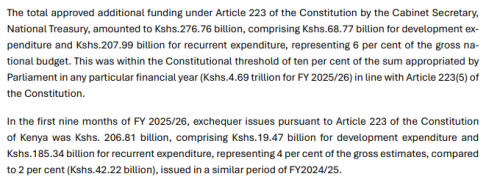
During the review period, the national government accessed Ksh206.81 billion under this provision. Of this:
- Ksh185.34 billion was used for recurrent expenditure
- Ksh19.47 billion was allocated to development spending
The National Treasury accounted for the largest share, withdrawing Ksh144.4 billion mainly for public debt servicing.
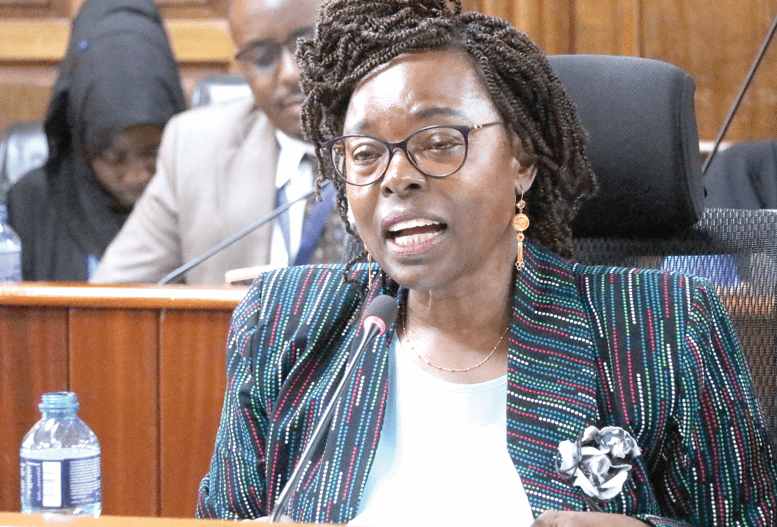
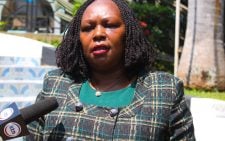
Controller of Budget Dr Margaret Nyakang’o flags the growing reliance on Article 223 as a concern, warning that it should be strictly reserved for unforeseen and emergency situations.
In Chapter 5 of the report, she calls for stronger controls to ensure better fiscal discipline and reduced dependence on supplementary withdrawals outside the approved budget framework.
Article 223 is designed to allow flexibility during genuine emergencies. However, the report indicates that repeated and large-scale use of the provision reduces Parliament’s oversight role in public expenditure.
The Controller of Budget notes that this trend was observed across several government entities during the first nine months of the financial year.
Author
Kenneth Mwenda
Kenneth Mwenda is a business, sports, and politics digital writer with over seven years of experience in journalism, covering breaking news, feature stories, and in-depth analysis across a range of beats.
For inquiries, he can be reached at [email protected]
View all posts by Kenneth MwendaLatest News


Advertisement
More on Business