Advertisement
CBK maintains key rate amid inflation and external pressures
Wednesday 08th April, 2026 06:24 PM|

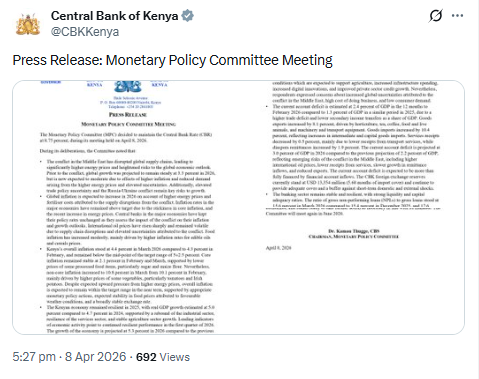
The Central Bank of Kenya (CBK) has held its key interest rate steady, after ten straight cuts that brought the Central Bank Rate (CBR) down to 8.75 per cent in February.
The Monetary Policy Committee wants to anchor inflation expectations while they watch for second-round effects and external risks. The MPC met amid fresh global worries. Conflict in the Middle East has disrupted supply chains and pushed energy prices higher.
Oil prices rose sharply and stayed volatile. Global growth, once projected at 3.3 percent for 2026, now faces downward pressure from higher inflation and weaker demand. Central banks in major economies kept their rates unchanged as they assessed the fallout.
Kenya’s headline inflation edged up to 4.4 per cent in March from 4.3 per cent in February. The figure stayed well inside the target band of 5 per cent plus or minus 2.5 per cent.
You Might Also Like



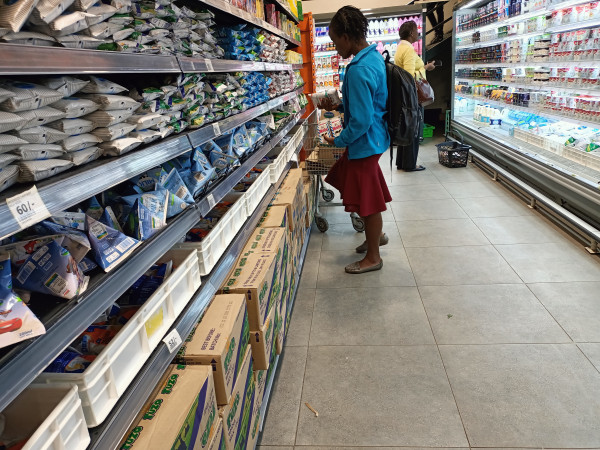
Core inflation held steady at 2.1 percent, helped by lower prices for some processed foods such as sugar and maize flour. Non-core inflation rose to 10.8 percent from 10.1 percent, driven mainly by higher costs for vegetables like tomatoes and Irish potatoes.
The CBK expects overall inflation to remain within the target range in the near term, supported by stable food prices from good weather and a steady exchange rate.
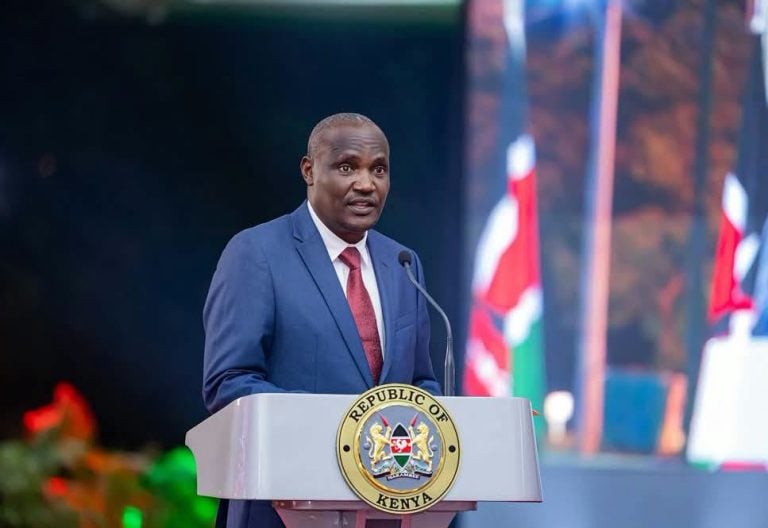
“The conflict in the Middle East has disrupted global supply chains, leading to significantly higher energy prices and heightened risks to the global economic outlook,” the MPC noted in its press release.
Kenya’s economy
Kenya’s economy grew at 5.0 percent in 2025, up from 4.7 percent the year before. The rebound came from a stronger industrial sector, steady services, and stable agriculture. Leading indicators suggest the economy performed well in early 2026.
Officials now project growth of 5.3 per cent for 2026, down from a previous forecast of 5.5 per cent. They cite risks from the Middle East conflict that could hit key sectors.
The current account deficit widened to 2.4 per cent of GDP in the 12 months to February 2026, compared with 1.3 percent a year earlier. Higher imports of intermediate and capital goods pushed the trade gap wider, even as goods exports rose 8.1 per cent on strong horticulture, tea, coffee and machinery sales.
Services receipts dipped slightly. Diaspora remittances grew 1.9 per cent. The CBK projects the deficit will reach 3.0 per cent of GDP in 2026, up from an earlier 2.2 per cent forecast, because of higher oil costs, possible slower remittances and weaker exports.
Financial inflows should still cover it fully. Foreign exchange reserves stood at USD 13.354 billion, equal to 5.68 months of import cover. The buffer remains solid against short-term shocks. The Kenya shilling stayed broadly stable.
Banking sector
In the banking sector, the ratio of gross non-performing loans to total loans rose to 15.6 per cent in March from 15.4 per cent in December 2025. It stayed below the 17.6 per cent peak seen in August 2025. Increases appeared in personal and household loans, trade, agriculture and manufacturing.
Banks continued to set aside adequate provisions. The sector kept strong liquidity and capital ratios.Private sector credit growth picked up to 8.1 percent in March from 7.4 per cent in February. This followed a low of minus 2.9 percent in January 2025. Demand improved in building and construction, trade, agriculture and consumer durables as lending rates fell.
Average commercial bank lending rates dropped to 14.7 per cent in March from 14.8 per cent the month before and 17.2 percent in November 2024. The new Risk-Based Credit Pricing Model, fully rolled out in March, should improve how policy rate changes reach borrowers and bring more transparency to loan pricing.
Business leaders showed continued optimism in the March surveys. They pointed to low inflation, stable exchange rates, lower interest rates, expected good weather for farming, more infrastructure spending and digital growth. Yet they flagged concerns over global uncertainty from the Middle East conflict, high business costs and soft consumer demand.
Farmers in the agriculture survey expect stable food prices thanks to favourable weather and steady exchange rates, though they now see some upward pressure on inflation from higher oil costs. The MPC kept the rate on hold to retain flexibility.
Author
Kenneth Mwenda
Kenneth Mwenda is a business, sports, and politics digital writer with over seven years of experience in journalism, covering breaking news, feature stories, and in-depth analysis across a range of beats.
For inquiries, he can be reached at [email protected]
View all posts by Kenneth MwendaLatest News







Advertisement
More on Business