Advertisement
KRA launches Advance Cargo Declaration platform for containerised cargo ahead of the August rollout
Tuesday 14th July, 2026 10:06 PM|

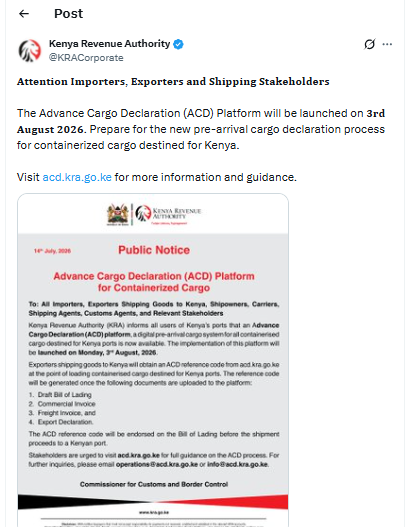
The Kenya Revenue Authority (KRA) has announced the rollout of a new Advance Cargo Declaration (ACD) Platform that will become mandatory for all containerised cargo destined for Kenya from August 3, 2026, in a move aimed at enhancing customs efficiency, strengthening cargo security, and improving trade facilitation.
The new digital platform will require exporters to submit cargo information and supporting documents before shipments are loaded for transportation to Kenya, allowing customs authorities to receive advance shipment data and conduct risk assessments before goods arrive at Kenyan ports.
According to a public notice issued by KRA on Tuesday, July 14, 2026, the system will apply to a wide range of stakeholders involved in international trade, including importers, exporters, shipowners, carriers, shipping agents, customs agents, freight forwarders, and cargo owners handling containerised cargo destined for the country.
The tax authority said the platform is part of ongoing efforts to modernise customs operations and improve visibility across the international supply chain, while facilitating the smooth movement of legitimate trade through Kenya’s ports of entry.
You Might Also Like



The introduction of the Advance Cargo Declaration Platform comes at a time when Kenya continues to position itself as a regional logistics and maritime hub, with the Port of Mombasa serving as a critical gateway for cargo destined for Kenya and several neighbouring countries in East and Central Africa.
What it means for importers and exporters
Under the new requirements, exporters shipping containerised cargo to Kenya will be required to obtain an ACD reference code before cargo is loaded for shipment. The code will be generated through the dedicated online platform after the submission and verification of mandatory shipping documents.
KRA has directed exporters to access the platform through the official ACD portal and upload a draft Bill of Lading, Commercial Invoice, Freight Invoice, and Export Declaration. Once the information is successfully processed, the system will generate a unique ACD reference code that must be endorsed on the Bill of Lading before the cargo proceeds to Kenya.
The authority noted that the requirement will apply to all containerized cargo destined for Kenyan ports, making compliance a critical step in the shipping process for businesses involved in international trade with Kenya.

For importers and exporters, the new system introduces an additional pre-shipment compliance requirement but is also expected to create greater predictability in cargo processing by ensuring customs authorities receive shipment information in advance.
Industry stakeholders are being encouraged to familiarise themselves with the new procedures ahead of the August 3 implementation date to avoid potential disruptions, delays, or compliance challenges once the system becomes operational.
Shipping lines, customs agents, freight forwarders, and cargo owners will also need to align their documentation processes with the new requirements to ensure cargo moves smoothly through the supply chain.
Why the ACD system matters
The implementation of the ACD Platform represents a significant milestone in Kenya’s customs modernisation agenda and reflects a growing global trend toward advanced cargo information systems that allow authorities to assess shipments before arrival.
By receiving cargo information earlier in the shipping cycle, customs officials can identify high-risk consignments, improve cargo tracking, strengthen border controls, and facilitate faster clearance for compliant shipments. The approach is expected to reduce inefficiencies associated with manual processes while enhancing transparency throughout the logistics chain.

The system is also expected to support more effective revenue administration by providing customs authorities with accurate shipment data before cargo reaches Kenyan territory. Early access to cargo information enables authorities to undertake targeted interventions where necessary while allowing low-risk cargo to move more efficiently through the clearance process.
For businesses, improved cargo visibility and streamlined customs procedures could contribute to reduced delays and better planning across supply chains. Importers, exporters, and logistics providers increasingly rely on predictable cargo movement to manage costs, inventory levels, and customer expectations, making efficient customs systems a key component of international trade competitiveness.
KRA has urged all affected stakeholders to take the necessary steps to understand the new requirements before the launch date and to seek guidance through the designated support channels where clarification may be required.
As Kenya continues to invest in digital customs solutions and trade facilitation initiatives, the Advance Cargo Declaration Platform is expected to play a central role in improving cargo management, enhancing border security, and supporting the country’s ambition to strengthen its position as one of Africa’s leading trade and logistics gateways.
Author
Latest News




Advertisement
More on Business