Advertisement
Willis Otieno warns against church–state overreach
Sunday 14th December, 2025 08:26 AM|

Willis Otieno has cautioned against what he described as mutual overreach between religious institutions and the State, calling for strict adherence to constitutional boundaries as debates intensify over proposed regulation of religious organisations.
Constitutional provisions under scrutiny
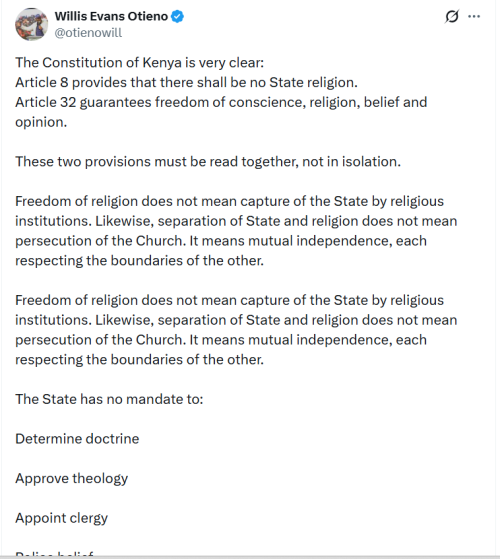
In a post on X dated December 14, 2025, Otieno grounded his argument in the Constitution, urging a balanced reading of key provisions.
“The Constitution of Kenya is very clear: Article 8 provides that there shall be no state religion. Article 32 guarantees freedom of conscience, religion, belief, and opinion. These two provisions must be read together, not in isolation,” he stated.
He warned that constitutional freedoms should not be interpreted to justify dominance by either side.
You Might Also Like



“Freedom of religion does not mean capture of the State by religious institutions. Likewise, the separation of state and religion does not mean persecution of the Church. It means mutual independence, each respecting the boundaries of the other,” Otieno said.
He repeated the point for emphasis, underlining what he termed a growing misunderstanding in public discourse: “Freedom of religion does not mean capture of the State by religious institutions. Likewise, separation of state and religion does not mean persecution of the Church. It means mutual independence, each respecting the boundaries of the other.”
Clergy oppose proposed regulation
The remarks came after leaders from the Ministry of Repentance and Holiness criticized the proposed regulation of churches, saying it violates Article 32 of the Constitution. The clergy were led by Senior Rt. Rev. Amos Wandera, the group’s General Overseer and Administrative Secretary, and were joined by Maj. Gen. (Rtd) George Kyana, Senior Archbishop Emeritus, and Senior Archbishop Michael Nieswand.
They argued that state oversight of religious institutions amounts to interference in matters of faith, doctrine, and conscience. Their position echoes concerns raised by other faith groups following attempts to introduce legislation governing religious organisations.
Limits on state and church authority
Otieno, however, drew a clear line on what the state can and cannot do. “The State has no mandate to determine doctrine, approve theology, appoint clergy, or police belief. That is where Article 32 draws the line,” he said.
At the same time, he cautioned religious bodies against overstepping their role in governance. “But the Church, equally, has no constitutional mandate to exercise state power, replace law with prophecy, convert public policy into religious decree, or shield criminality under the cover of faith,” Otieno stated.
He concluded by stressing accountability where public interest is involved: “Where public money, public safety, fraud, abuse, or exploitation arise, the law applies.”
Author
Latest News








Advertisement
More on Sports