Advertisement
AIU suspends Kenya’s Lydia Cheptarus for 2 years over doping
Wednesday 19th November, 2025 12:46 PM|
The Athletics Integrity Unit (AIU) has suspended Kenyan runner Lydia Cheptarus for two years after failing an anti-doping test.
According to AIU, on September 28, 2025, the athlete provided a urine sample in competition at the Casablanca International Challenge held in Morocco, pursuant to testing conducted under the testing authority of World Athletics-AIU, which was given code 1634739 (the “Sample”).
Tracing the doping footsteps
On October 27, 2025, the World Anti-Doping Agency (“WADA”) accredited laboratory in Lausanne, Switzerland (the “Laboratory”) reported an adverse analytical finding in the sample based on the presence of triamcinolone acetonide (the “Adverse Analytical Finding”).
Thereafter, the AIU reviewed the adverse analytical finding in accordance with Article 5 of the International Standard for Results Management (“ISRM”) and determined that the athlete did not have a Therapeutic Use Exemption (“TUE”) that had been granted for the triamcinolone acetonide found in the sample.
You Might Also Like



The AIU also established that there was no apparent departure from the International Standard for Testing and Investigations (“ISTI”) or from the International Standard for Laboratories (“ISL”) that could reasonably have caused the adverse analytical finding. It was not apparent that the adverse analytical finding was caused by an ingestion of the relevant prohibited substance through a permitted route.
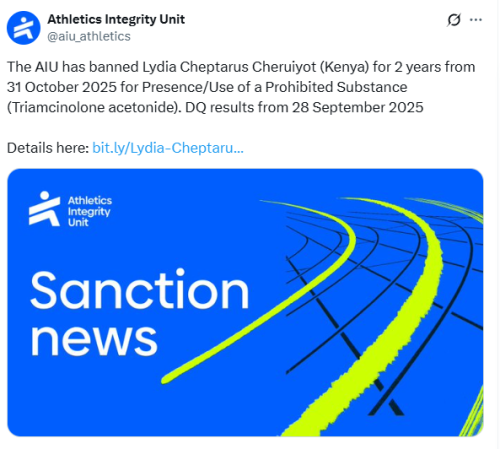
”Therefore, on October 29, 2025, the AIU notified the athlete of the adverse analytical finding in accordance with Article 5.1.2.1 of the ISRM, including that the Adverse Analytical Finding may result in anti-doping rule violations pursuant to Rule 2.1 ADR and/or Rule 2.2 ADR. The athlete was also informed of her rights, inter alia, to request the B sample analysis, to request copies of the laboratory documentation supporting the adverse analytical finding and to admit the anti-doping rule violations,” AIU said in a statement dated Wednesday, November 19, 2025.
The statement also added that on October 31, 2025, the AIU received an admission of anti-doping rule violations and acceptance of consequences form signed by the athlete.
Consequences
Triamcinolone acetonide is a prohibited substance under the WADA 2025 Prohibited List under the category S9. Glucocorticoids. It is a specified substance prohibited in competition when administered by any injectable, oral (including oromucosal) or rectal route.
The period of ineligibility to be imposed is therefore a period of two (2) years, unless the AIU demonstrates that the anti-doping rule violations were intentional. However, the AIU has no evidence that the anti-doping rule violations were intentional, and the mandatory period of ineligibility to be imposed is therefore a period of two (2) years.
Author
Latest News








Advertisement
More on Sports