Advertisement
Willis Otieno rejects Ruto’s fuel price argument, says taxes, not income drive costs
Sunday 19th April, 2026 04:31 PM|

Lawyer and political commentator Willis Evans Otieno has dismissed President William Ruto’s explanation that Kenya’s fuel prices are higher because the country is classified as a middle-income economy, saying the argument does not reflect how pricing works in practice.
In a post on X on Sunday, April 19, 2026, Otieno said income classification should not be used to justify higher fuel costs for citizens.
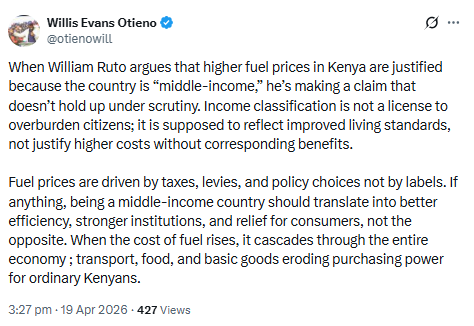
“When William Ruto argues that higher fuel prices in Kenya are justified because the country is ‘middle-income,’ he’s making a claim that doesn’t hold up under scrutiny,” he said.
Otieno argued that a country’s income status should reflect better living conditions, not higher consumer costs. He said governments should use that status to improve efficiency and ease pressure on households.
You Might Also Like



“Income classification is not a license to overburden citizens; it is supposed to reflect improved living standards, not justify higher costs without corresponding benefits,” he said.
His remarks come after Ruto defended Kenya’s fuel prices during a Sunday service at Karen Africa Gospel Church, where he said comparisons with neighbouring countries are misleading because Kenya falls under a different economic category.

Fuel price policy debate
The President said Kenya should be compared with other middle-income countries and not least developed economies in the region. He also linked fuel prices to taxation levels and infrastructure costs, including road construction and maintenance.
But Otieno pushed back on that reasoning, saying fuel prices are determined by policy decisions rather than labels.
“Fuel prices are driven by taxes, levies, and policy choices, not by labels,” he said.
He added that higher fuel costs affect the wider economy beyond transport, warning that price increases spread quickly through essential goods and services.
“When the cost of fuel rises, it cascades through the entire economy; transport, food, and basic goods erode purchasing power for ordinary Kenyans,” he said.
Ruto had earlier argued that Kenya’s large road network and ongoing infrastructure projects justify part of the fuel-related charges, saying fuel revenue supports maintenance and expansion.
However, Otieno maintained that efficient taxation and policy choices would matter more than economic classification in determining pump prices.
His comments add to growing public debate over fuel costs, which remain a key pressure point for households facing high living expenses across the country.
Author
Kenneth Mwenda
Kenneth Mwenda is a business, sports, and politics digital writer with over seven years of experience in journalism, covering breaking news, feature stories, and in-depth analysis across a range of beats.
For inquiries, he can be reached at [email protected]
View all posts by Kenneth MwendaLatest News








Advertisement
More on News