Willis Otieno: Kenya’s prosperity cannot be built on endless debt
By Sharon Atieno, June 12, 2026Lawyer and governance analyst Willis Otieno has called for a radical shift in Kenya’s economic model, arguing that the country can no longer rely on endless borrowing if it hopes to achieve sustainable growth and improve citizens’ livelihoods.
In a statement shared on his X account on Friday, June 12, 2026, Otieno said Kenya must move away from debt-driven development and embrace a citizen-led economy built on production, investment and consumption by ordinary wananchi under what he termed the FIST Agenda.
“Kenya’s prosperity will not be built through endless borrowing but by empowering ordinary citizens to produce, invest and consume,” he said.
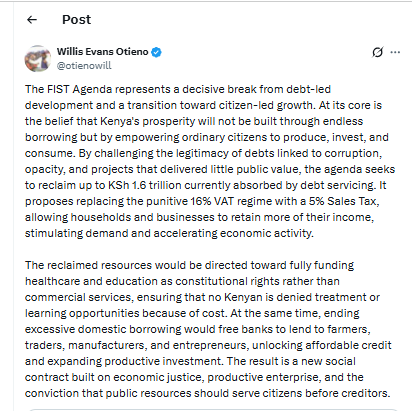
Otieno argued that the country has over the years become trapped in a system where public resources are increasingly directed towards debt repayment instead of improving the welfare of citizens.
Sh1.6 trillion tied up in debt servicing
According to Otieno, part of the proposed reforms involves challenging the legitimacy of debts linked to corruption, opaque agreements and projects that delivered little value to the public.
He said the country could reclaim up to Sh1.6 trillion currently being absorbed by debt servicing if questionable debt obligations are reviewed.
“By challenging debts linked to corruption, opacity and projects that delivered little public value, we can reclaim up to Sh1.6 trillion currently absorbed by debt servicing,” he said.
Push for lower taxes and stronger public services
Otieno further proposed replacing the current 16 per cent VAT regime with a 5 per cent sales tax to allow households and businesses to retain more income and stimulate economic activity.
He said the resources recovered through debt reforms should be redirected towards fully funding healthcare and education as constitutional rights rather than treating them as commercial services.
“The result is a new social contract built on economic justice, productive enterprise and the conviction that public resources should serve citizens before creditors,” he said.
He added that reducing excessive domestic borrowing would free banks to lend more affordably to farmers, traders, manufacturers and entrepreneurs, unlocking growth across productive sectors of the economy.
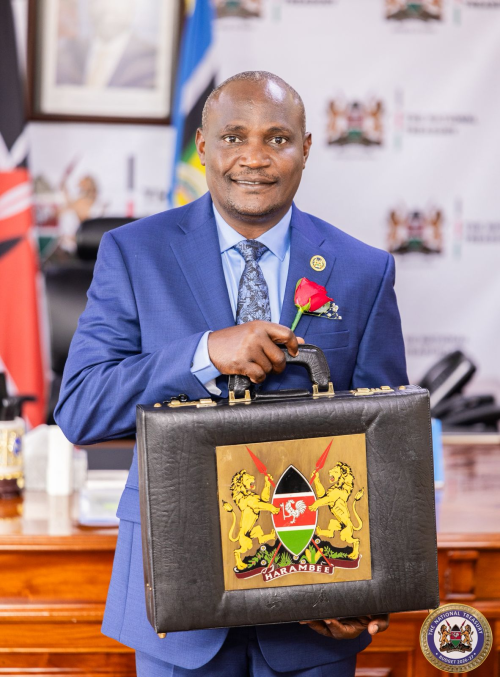
His remarks come amid growing concern over Kenya’s rising debt burden after Treasury Cabinet Secretary John Mbadi revealed the government is seeking to plug a projected Sh1.1 trillion budget deficit largely through improved domestic revenue collection.
Speaking ahead of the 2026/27 budget presentation, Mbadi said the government is relying on tax administration reforms and stronger Kenya Revenue Authority collections as borrowing options become increasingly constrained by global economic pressures.
The Treasury has projected about Sh116 billion in external borrowing, with the remaining deficit expected to be financed domestically, further intensifying the debate over Kenya’s debt sustainability and long-term economic direction.