Advertisement
Willis Otieno calls for self-regulation of religious institutions
Sunday 14th December, 2025 08:29 PM|

A fresh push by the state to create a statutory framework for religious organisations has reopened a sensitive national debate: how to stop harmful, exploitative groups while protecting the constitutional right to freedom of religion.
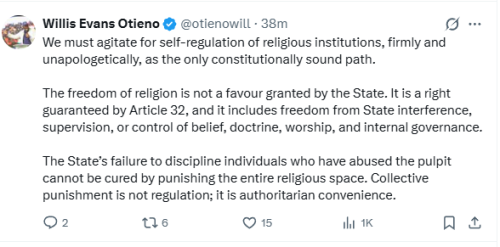
Speaking on the move, city lawyer Willis Otieno has sided against the proposal. In a statement on Sunday, December 14, 2025, Otieno said, “We must agitate for self-regulation of religious institutions, firmly and unapologetically, as the only constitutionally sound path.”
Government’s proposal
The government’s proposals, developed by a presidential task force after the Shakahola cult tragedy, include a Draft Religious Organisations Policy and the Religious Organisations Bill (2024).
Together they aim to provide a “legislative framework” for registration, oversight and accountability of faith groups, including a proposed Registrar or Religious Affairs Commission, registration requirements and sanctions for non-compliance.
You Might Also Like



The draft bill and policy were produced after the Taskforce presented recommendations to the Executive, and the documents have been circulated for public consultation.
Government proponents point to the Shakahola killings and other abuses by rogue sects as evidence that existing laws and enforcement have not been sufficient to prevent exploitation and extremism inside some religious movements.
Also watch: Kieni pastors condemn proposed Bill to regulate churches
The Cabinet has signalled support for reforms designed to curb dangerous practices and to institute standards of leadership accountability, and officials have called for public input as the policy and bill are finalised.
Right to worship
”The freedom of religion is not a favour granted by the State. It is a right guaranteed by Article 32, and it includes freedom from State interference, supervision, or control of belief, doctrine, worship, and internal governance. The State’s failure to discipline individuals who have abused the pulpit cannot be cured by punishing the entire religious space. Collective punishment is not regulation; it is authoritarian convenience,” Otieno argued.
Religious bodies, umbrella church networks and individual clerics have warned that the draft law risks turning faith groups into government-regulated entities in ways that could choke freedom of worship, criminalise legitimate internal practices, or make the State the arbiter of doctrine and belief.
Objections centre on the composition and powers of proposed oversight bodies, mandatory registration and heavy penalties. Willis Otieno has reminded the public that freedom of religion is a right (Article 32 of the 2010 Constitution) and “is not a favour granted by the State.”
Author
Latest News





Advertisement
More on News