Advertisement
Willis Otieno blasts high taxes, says Kenyans are overburdened as wages stagnate
Monday 18th May, 2026 08:10 AM|

Lawyer and political commentator Willis Otieno has sharply criticised Kenya’s tax regime and rising cost of living, arguing that citizens are being overburdened while wages remain largely stagnant.
In a statement shared via his official X account on Monday, May 18, 2026, Otieno said the cumulative effect of fuel price hikes, new levies, and rising service costs has turned daily survival into a growing challenge for ordinary Kenyans.
Rising cost of living pressure
The Safina deputy party leader noted that increases in fuel prices have triggered a ripple effect across the economy, leading to higher matatu fares, increased electricity costs, rising rent, and escalating food prices.
He said the adjustments in transport and energy costs are quickly passed down to consumers, worsening inflation and eroding household incomes.
You Might Also Like



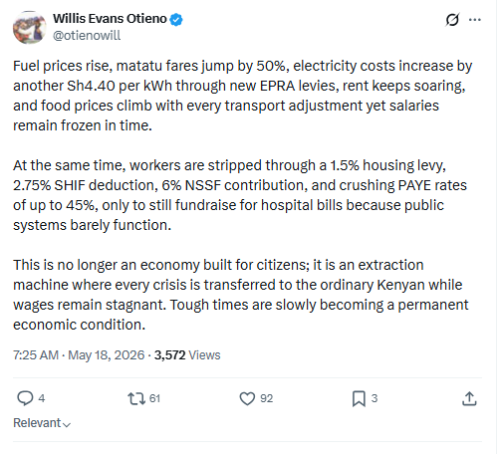
“Fuel prices rise, matatu fares jump by 50%, electricity costs increase by another Sh4.40 per kWh through new EPRA levies, rent keeps soaring, and food prices climb with every transport adjustment, yet salaries remain frozen in time,” Otieno stated.

Criticism of taxes and statutory deductions
The lawyer also took issue with multiple statutory deductions affecting workers’ salaries, including the housing levy, SHIF contributions, NSSF rates, and PAYE taxes.
He argued that despite these deductions, many Kenyans still rely on public fundraising to meet basic healthcare needs due to gaps in service delivery.
“At the same time, workers are stripped through a 1.5% housing levy, 2.75% SHIF deduction, 6% NSSF contribution, and crushing PAYE rates of up to 45%, only to still fundraise for hospital bills,” he said.
Otieno warned that Kenya’s economic structure is increasingly functioning as an “extraction machine” where every economic shock is transferred to citizens, while wages remain unchanged.
He said the burden of taxation and rising prices is not matched by improvements in public services or income growth.
“This is no longer an economy built for citizens; it is an extraction machine where every crisis is transferred to the ordinary Kenyan while wages remain stagnant,” he said.
His remarks come amid ongoing national debate over taxation, fuel pricing, and the rising cost of living, which has seen pressure mount on the government to introduce relief measures.
Fuel price fluctuations, in particular, continue to drive increases in transport costs and basic commodities, further straining household budgets.
The remarks come amid the nationwide transport strike over rising fuel prices.
The strike involves multiple transport subsectors, including matatu operators, boda boda associations, ride-hailing drivers, cargo transporters, tourist vehicle operators, school transport providers, and private motorists.
The Transport Sector Alliance says the industrial action is aimed at protesting recent fuel price hikes, which stakeholders argue have worsened the already high cost of living.
Transport operators maintain that increasing fuel costs have triggered fare hikes, higher commodity prices, and mounting economic pressure on ordinary Kenyans.
Private vehicles have also been warned to keep off the roads in solidarity with the ongoing strike.
Author
Mustafa Juma
View all posts by Mustafa JumaLatest News








Advertisement
More on News