Advertisement
WHO lists key steps to protecting children from eye diseases
Tuesday 21st April, 2026 07:28 AM|

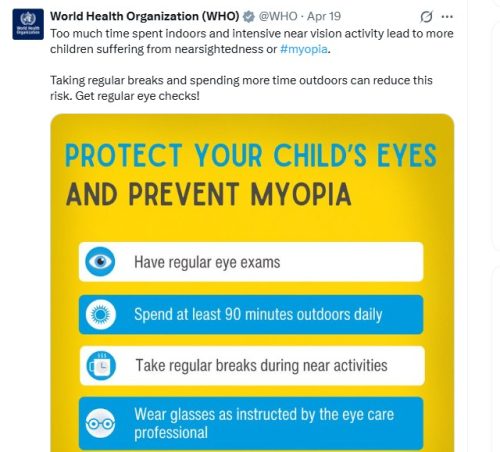
The World Health Organisation has shared key measures parents and guardians can take towards protecting their children from eye conditions identified as Myopia.
In a report shared on the WHO official X account on Sunday, April 19, 2026, the WHO warned against children spending too much time indoors.
Hence, the WHO has urged parents to take regular breaks and spend more time outdoors, which can reduce this risk as well as getting regular eye check up for the young ones.
“Too much time spent indoors and intensive near vision activity lead to more children suffering from nearsightedness or #myopia. Taking regular breaks and spending more time outdoors can reduce this risk. Get regular eye checks!,” WHO stated.
You Might Also Like
At the same time, the organisation warned that Eye conditions are remarkably common and that those who live long enough will experience at least oneduring their lifetime.
According to the WHO, globally, at least 1 billion people have near- or distance-vision impairment that could have been prevented or has yet to be addressed. In the absence of timely detection, reduced or absent eyesight can have long-term personal and economic effects.
Vision impairment affects people of all ages, with the majority being over the age of 50.
On the other hand, WHO notes that young children with early onset severe vision impairment can experience lower levels of educational achievement, and in adults it often affects quality of life through lower productivity, decreased workforce participation and high rates of depression.
Vision impairment and blindness impact the life of people everywhere. In low- and middle-income settings the burden of vision impairment can be even greater due to fewer opportunities to access the most essential eye care services.
Cataracts and uncorrected refractive errors are estimated to be the leading causes of vision impairment; however, other causes for vision impairment cannot be ignored.
Age-related macular degeneration, glaucoma, long-standing systemic conditions like diabetes causing diabetic retinopathy, infectious diseases of the eye and trauma to the eye are all equally important causes for vision impairment that need to be addressed.
Author
Latest News





Advertisement
More on News