Who gave the orders? Willis Otieno demands answers before protest victims are paid
By Mustafa Juma, June 29, 2026Constitutional lawyer Willis Otieno has challenged the government’s Ksh2 billion compensation plan for victims of protest-related violence, arguing that reparations cannot replace accountability for those responsible for the killings and injuries witnessed during recent demonstrations.
Otieno, in a statement shared via his official X account on Monday, June 29, 2026, directed his remarks at Prof. Makau Mutua, who chairs the government-appointed Panel of Experts overseeing the compensation and reparations programme announced by President William Ruto earlier this month.
The government has set aside Ksh2 billion to compensate individuals who suffered verified harm arising from protests dating back to 2017, with the panel tasked with receiving claims, verifying victims and recommending compensation. The initiative is intended to provide reparations for victims of extrajudicial killings, injuries, arbitrary arrests and other human rights violations linked to public demonstrations.
Financial compensation over justice
However, Otieno questioned whether the programme risks prioritising financial compensation over justice.
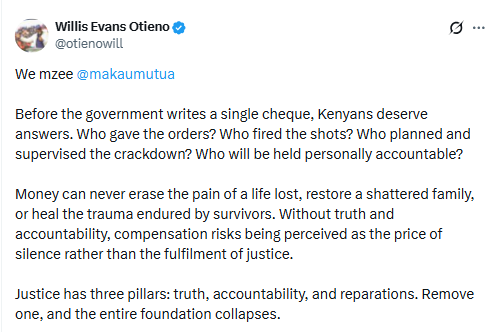
“We mzee @makaumutua. Before the government writes a single cheque, Kenyans deserve answers. Who gave the orders? Who fired the shots? Who planned and supervised the crackdown? Who will be held personally accountable?” Otieno posed.
“Money can never erase the pain of a life lost, restore a shattered family, or heal the trauma endured by survivors. Without truth and accountability, compensation risks being perceived as the price of silence rather than the fulfilment of justice. Justice has three pillars: truth, accountability, and reparations. Remove one, and the entire foundation collapses.”
His remarks add to a growing national debate over the sequencing of justice following the deadly anti-government protests that have rocked the country in recent years.
Makau Mutua was appointed by President Ruto to lead the Panel of Experts on Compensation of Victims of Human Rights Violations. The panel is mandated to design and oversee a transparent framework for identifying eligible victims, assessing claims, and recommending compensation from the Ksh2 billion fund.
Mutua has maintained that the compensation initiative is intended to provide reparations to victims and their families, while stressing that it does not replace the pursuit of justice or criminal accountability for those responsible for human rights violations.
The panel includes representatives drawn from the legal profession, civil society and human rights organisations and is expected to oversee compensation for victims of protest-related violations dating back to 2017.
Calls for accountability
Otieno’s statement reflects concerns expressed by sections of the legal fraternity and civil society that compensation should not be viewed as a substitute for investigations into the conduct of security agencies during protests.
His demand for answers on who authorised the use of force, who commanded police operations and who will ultimately face prosecution echoes longstanding calls by human rights groups for independent investigations into alleged extrajudicial killings and excessive use of force during demonstrations.
The lawyer warned that without establishing the truth and holding perpetrators individually accountable, compensation alone could be interpreted as an attempt to close the chapter on the protests without addressing the underlying injustices.
His intervention comes as the government’s reparations programme continues to attract both praise from families seeking redress and criticism from those who insist that justice requires more than financial compensation.
The Panel of Experts is expected to continue receiving and verifying claims before recommending payouts to eligible victims, even as debate persists over how Kenya should balance reparations with truth, accountability and institutional reform.