Advertisement
WhatsApp defends encryption system amid privacy lawsuit claims
Saturday 11th April, 2026 08:15 AM|

WhatsApp has rejected claims questioning the strength of its end-to-end encryption, insisting that user chats remain private and inaccessible to third parties, including the company itself.
In a statement posted on X on April 10, 2026, WhatsApp described citations contained in a California class-action lawsuit as “categorically false and absurd.” The company said: “WhatsApp has been end-to-end encrypted using the Signal protocol for a decade, so your messages cannot be read by anyone other than the sender and recipient.”
The lawsuit was filed in a federal court in California by Brian Y. Shirazi and Nida Samson. It names WhatsApp, parent company Meta Platforms, and consulting firm Accenture, accusing them of intercepting, storing, accessing and sharing private messages without user consent.
The plaintiffs claim the companies marketed WhatsApp as a secure messaging platform while allowing employees and third-party contractors access to content described as encrypted. The filing also references whistleblower reports submitted to federal investigators as part of the evidence.
Impact on users and digital services in Kenya
You Might Also Like



The debate has drawn attention in Kenya following the Kenya Revenue Authority’s rollout of a WhatsApp-based tax filing service on April 1, 2026. The system allows taxpayers to submit returns through the messaging app, with pre-filled forms, step-by-step guidance and real-time support.
KRA has described the service as a tool to simplify tax filing and improve compliance among the country’s more than 22 million registered taxpayers.
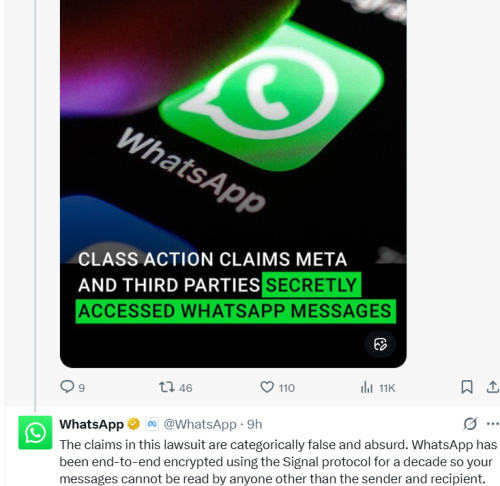
Encryption claims and company response
WhatsApp and Meta have dismissed the citations, maintaining that the platform’s encryption system ensures only the sender and recipient can access messages. The company reiterated that its services have used the Signal protocol for over a decade.
Meta referred further questions back to WhatsApp’s official statement and cited earlier remarks by WhatsApp leadership rejecting similar claims as unfounded.
WhatsApp said its position on privacy remains unchanged since its acquisition by Meta in 2014, when it committed to protecting user communication through end-to-end encryption.
The case remains in its early stages in the United States court system.
Global reactions and tech industry debate
The lawsuit has attracted attention from major figures in the technology sector. Elon Musk posted on X, writing “Can’t trust WhatsApp.” Telegram founder Pavel Durov also criticised WhatsApp’s security claims, describing its encryption as “may be the biggest consumer fraud in history” and contrasting it with Telegram’s privacy practices.
WhatsApp has rejected similar criticisms in the past, maintaining that no one outside a conversation, including the platform itself, can access messages, calls or shared media.
Author
Latest News








Advertisement
More on News