Wamuchomba questions tea export figures Ruto cited in his State of the Nation address
By Faith Lagat, November 20, 2025Githunguri Member of Parliament Gathoni Wamuchomba has questioned President William Ruto’s claim that tea export earnings rose from Ksh138 billion in 2022 to Ksh215 billion in 2024, describing the figures as disconnected from the experiences of smallholder farmers.
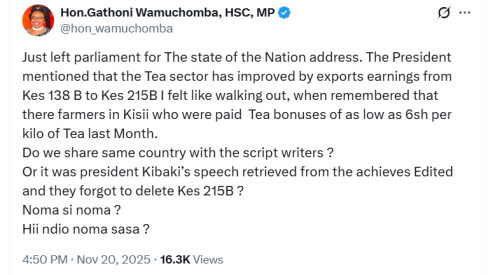
Moments after the President delivered the State of the Nation Address on November 20, Wamuchomba posted on X, highlighting the discrepancy between national earnings and the low tea bonuses paid to farmers.
“Just left parliament for the State of the Nation address. The President mentioned that the tea sector has improved, with export earnings increasing from Ksh138 billion to Ksh215 billion. I felt like walking out when I remembered that there were farmers in Kisii who were paid tea bonuses of as low as Ksh6 per kilo of tea last month,” she wrote.
The lawmaker questioned whether the figures cited reflected current realities or were outdated.
“Do we share the same country with the scriptwriters? Or was it President Kibaki’s speech retrieved from the archives, edited, and they forgot to delete Ksh215B? Noma si noma? Hii ndio noma sasa?” she asked.
Disparities across regions
Wamuchomba’s reaction follows similar concerns raised in the Senate by Nandi County Senator Samson Cherargei, who highlighted wide disparities in the 2025 Kenya Tea Development Agency (KTDA) bonus payouts.
Cherargei pointed out that West Rift regions such as Kericho and Bomet saw significant declines in bonuses compared to East Rift counties like Kiambu and Nyeri. He questioned KTDA’s evaluation methods and urged reforms to ensure that pricing and bonus structures reflect equity and regional fairness.
“KTDA attributes this variation to tea quality, yet concerns have emerged regarding the objectivity, consistency, and transparency of its evaluation methods, particularly the continued reliance on oenological (in brackets, sensory) testing, or use of the tongue for people who don’t speak English, and the absence of independent oversight,” he said.
KTDA attributed the lower bonuses to global market conditions and a stronger Kenyan shilling, which moved from Ksh144 to Ksh129 against the US dollar in 2025.
The contrasting narratives—one highlighting a 56% rise in national export earnings and another showing farmers receiving as little as Ksh 6 per kilo- have reignited debates on transparency and fairness within Kenya’s multi-billion-shilling tea sector.