Advertisement
US terror designation raises questions over Sudan’s SAF links
Wednesday 18th March, 2026 03:25 PM|

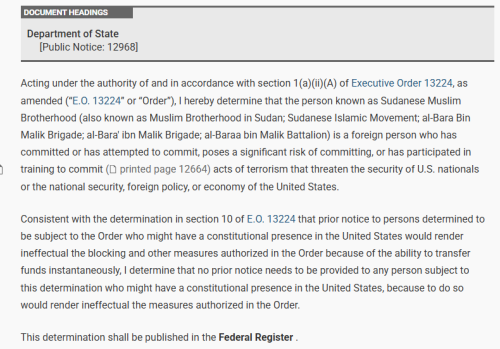
The United States’ decision to designate the Sudanese Muslim Brotherhood as a Foreign Terrorist Organisation (FTO) on March 16, 2026, is already changing how Sudan’s war is viewed abroad, with fresh scrutiny now falling on the Sudanese Armed Forces (SAF).
For much of the conflict, the fighting between SAF and the Rapid Support Forces (RSF) has been seen as a power struggle between two rival military groups. The new designation adds a political and ideological layer, bringing the claimed Islamist links into sharper focus.
The US State Department said the group would be treated as a terrorist organisation under American law, making it illegal to offer it any form of material support.
“The Sudanese Muslim Brotherhood uses unrestrained violence against civilians to undermine efforts to resolve the conflict in Sudan and advance its violent Islamist ideology,” US Secretary of State Marco Rubio said.
You Might Also Like

The move followed an earlier classification of the group as a Specially Designated Global Terrorist (SDGT), which already allowed Washington to impose economic sanctions.
Under US law, an FTO designation carries wider consequences. It criminalises support, restricts financial flows, and places pressure on international partners to follow suit. It also signals a clear policy stance that can shape diplomatic engagement.
That is where the pressure on SAF begins to build.
Sudan’s army faces questions
For years, analysts and investigative reports have documented the influence of Islamist networks – many with roots in the era of former president Omar al-Bashir – within Sudan’s military and political institutions.
Bashir’s government (1989–2019) was closely aligned with Islamist movements, including the Sudanese Islamic Movement (Sudan’s branch of the Muslim Brotherhood).
Those links have never fully disappeared, according to observers. With Washington now formally blacklisting the Sudanese Muslim Brotherhood, attention is shifting towards actors believed to have maintained such connections.
While the US has not directly accused SAF of supporting the group, the designation has raised questions in diplomatic circles about who holds influence within the army.
In contrast, RSF has long framed its campaign as a fight against Islamist control. Its leaders have repeatedly claimed they are resisting a return to the kind of rule seen under al-Bashir.
That argument may now gain more traction internationally, even though RSF itself faces serious claims over human rights abuses.
The group has been accused by rights organisations of abuses against civilians during the war. However, in terms of messaging, it has positioned itself against Islamist factions, a stance that aligns more closely with the latest US move.
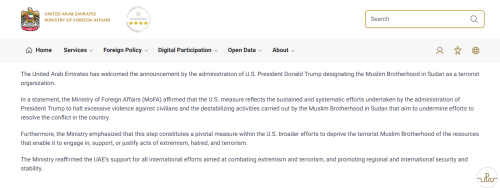
Some regional players have already welcomed Washington’s decision. The United Arab Emirates, which has taken an interest in Sudan’s stability, described the designation as part of efforts to curb violence and destabilising activity.
“The US measure reflects sustained efforts to halt excessive violence against civilians,” the UAE Ministry of Foreign Affairs said.
Legal and political fallout
The designation process itself follows strict legal criteria. Under US law, the State Department must show that a group engages in, or has the capacity and intent to engage in, terrorist activity that threatens American nationals or national security.
Once designated, organisations can challenge the decision in US courts, but the immediate effects are significant. Financial institutions must freeze any assets linked to the group, and individuals associated with it can face travel bans.
In Sudan’s case, the implications go beyond legal measures.
Diplomats say the move could affect how foreign governments and aid agencies deal with actors on the ground. Any perceived link to a designated organisation may complicate engagement, funding, and coordination.
That could place SAF in a difficult position if concerns over Islamist ties grow stronger.
At the same time, the designation reflects a wider shift in US policy. Washington appears to be placing greater emphasis on ideological affiliations in conflict zones, not just battlefield conduct.
This approach signals to allies that political alignment matters when deciding who to engage with or support.
For Sudan, the war is no longer only about territory or military strength. It is also about legitimacy.
The US decision has introduced a new test: which side is seen as aligned with internationally accepted norms, and which is viewed as linked to groups now branded as terrorist.
That shift does not settle the conflict, nor does it clear RSF of wrongdoing. But it does change the conversation.
Author
Kenneth Mwenda
Kenneth Mwenda is a business, sports, and politics digital writer with over seven years of experience in journalism, covering breaking news, feature stories, and in-depth analysis across a range of beats.
For inquiries, he can be reached at [email protected]
View all posts by Kenneth MwendaLatest News

Advertisement
More on News