Advertisement
Uproar as TSC absorbs only 20K of 44K intern teachers permanently
Thursday 14th May, 2026 11:49 AM|

A fresh storm has erupted in Kenya’s education sector after the Teachers Service Commission (TSC) confirmed that only 20,000 out of the 44,000 intern teachers currently serving across the country will be absorbed into permanent and pensionable terms in the 2026/27 Financial Year.
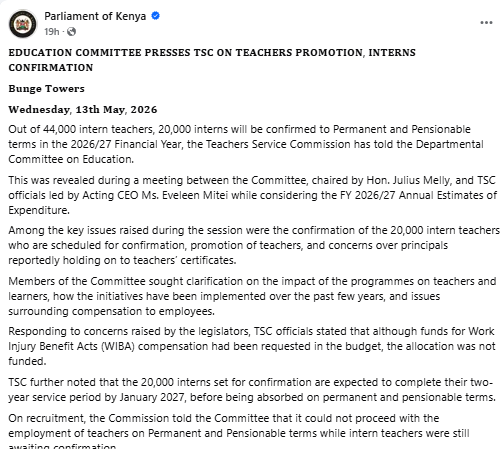
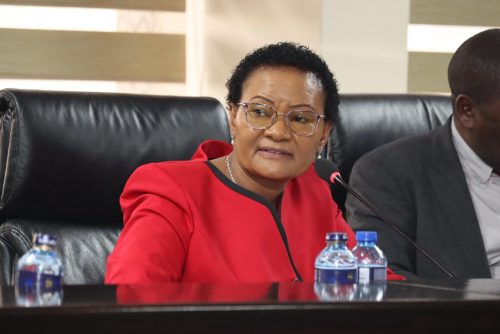
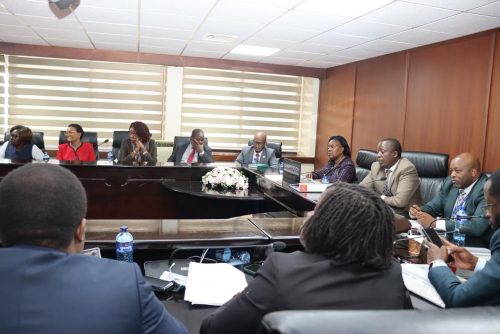
The revelation was made on Wednesday, May 13, 2026, during a meeting between the National Assembly Departmental Committee on Education and TSC officials led by Acting Chief Executive Officer Eveleen Mitei as lawmakers considered the 2026/27 Annual Estimates of Expenditure.
According to the Commission, the 20,000 intern teachers earmarked for confirmation are expected to complete their mandatory two-year internship period by January 2027 before transitioning into permanent employment.
The announcement has triggered widespread criticism from teachers’ unions, lawmakers, and education stakeholders, who argue that leaving nearly half of the intern teachers without job security could deepen the staffing crisis already facing public schools.
You Might Also Like



During the parliamentary session chaired by Tinderet MP Julius Melly, members of the Education Committee pressed TSC officials to explain the impact of the programme on both teachers and learners.
Lawmakers questioned how internship initiatives have been implemented over the years and sought clarification on issues surrounding teacher promotions, compensation, and claims that some school principals were withholding teachers’ academic certificates.
“Among the key issues raised during the session were the confirmation of the 20,000 intern teachers who are scheduled for confirmation, promotion of teachers, and concerns over principals reportedly holding on to teachers’ certificates,” the committee noted.
TSC officials further told the committee that the Commission could not proceed with fresh recruitment of teachers on permanent and pensionable terms while thousands of intern teachers were still awaiting confirmation.
The Commission also disclosed that although funds for Work Injury Benefits Act (WIBA) compensation had been requested in the budget, the allocation was not funded, adding another layer of concern regarding teacher welfare.
TSC under pressure
The latest development comes just days after Emuhaya MP and Kenya Union of Post-Primary Education Teachers (KUPPET) National Chairman Omboko Milemba called for the immediate employment of all 44,000 intern teachers on permanent and pensionable terms.
Milemba’s push follows a landmark Court of Appeal ruling delivered on February 27, 2026, which declared the Teachers Internship Programme unconstitutional, discriminatory, and illegal.
The ruling placed TSC in a difficult position, forcing the Commission to either absorb all the teachers permanently or risk creating a massive staffing shortage in schools.
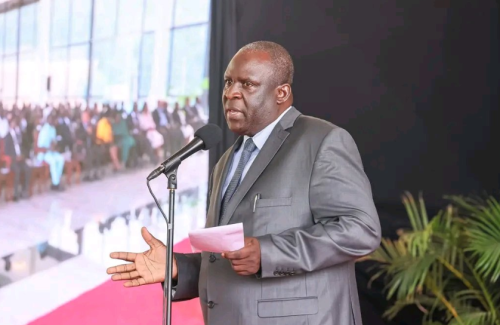
Speaking during a televised interview on March 24, 2026, Milemba criticised the continued use of internship arrangements for trained teachers.
“The internship programme is declared illegal by the courts. The Teachers Service Commission must now quickly change and move to Parliament. Once they must have apologised to the teachers whom they employed wrongly, because it was illegal,” Milemba said.
He further insisted that the internship programme should be scrapped entirely.
“They must cease from employing any other teacher as interns. I have done several petitions in Parliament to have teachers employed on a permanent and pensionable basis. Come to Parliament, get the budget. These teachers are suffering,” he added.
Despite growing pressure, TSC says absorbing all 44,000 intern teachers at once would significantly increase the government’s wage bill.
The Commission is reportedly grappling with a Ksh2.5 billion monthly budget deficit, translating to approximately Ksh30 billion annually. Education stakeholders warn that the financial strain could complicate implementation of the court ruling.
The government is also nearing the conclusion of its supplementary budget process, with no prior allocation made to facilitate the mass hiring of intern teachers.
However, education experts warn that failure to absorb the teachers could destabilise learning, especially in junior secondary schools where many interns currently serve.
“The country must make a choice. Either we invest in our teachers and secure the future of education, or we risk a collapse in the system due to understaffing,” Milemba warned.
Fear of teacher shortages in schools
The uncertainty surrounding the fate of the remaining 24,000 intern teachers has sparked anxiety across the education sector.
Teacher unions argue that many schools, particularly junior secondary institutions under the Competency-Based Curriculum (CBC), heavily rely on intern teachers to manage increasing student enrolment.
If the contracts are terminated without immediate replacement, schools could face severe teacher shortages, disrupting learning for millions of students nationwide.
Stakeholders have also reignited debate over teacher employment policies, with unions demanding fair labour practices and sustainable funding for education.
Many teachers have expressed frustration over years of serving under internship contracts with lower pay, limited benefits, and no long-term employment guarantee, despite performing duties similar to those of permanently employed teachers.
As pressure mounts, attention has now shifted to Parliament and the National Treasury to determine whether additional funds can be allocated to fully absorb all the intern teachers.
For now, thousands of intern teachers remain in limbo, uncertain whether they will secure permanent jobs or continue serving under temporary contracts amid growing legal and financial battles surrounding the programme.
Author
Latest News







Advertisement
More on News