Advertisement
Uganda approves groundbreaking twice-yearly HIV PrEP drug
Monday 05th January, 2026 05:13 PM|

Uganda’s National Drug Authority approved Lenacapavir, a twice-yearly injectable pre-exposure prophylaxis (PrEP) for HIV prevention, on January 5, 2025.
The drug was developed by US-based Gilead Sciences. Clinical trials showed it prevents HIV infection with 100 per cent effectiveness in high-risk groups.
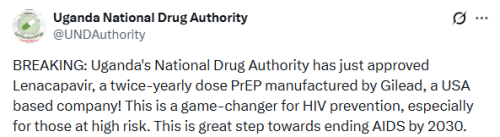
“Uganda’s National Drug Authority has just approved Lenacapavir, a twice-yearly dose of PrEP manufactured by Gilead, a USA-based company! This is a game-changer for HIV prevention, especially for those at high risk. This is a great step towards ending AIDS by 2030,” the authority stated in an X post.
This approval is a major step for sub-Saharan Africa, where HIV infections remain high. Gilead has already begun shipments to the region and aims to secure regulatory approval in 18 countries by the end of 2025, covering 70 per cent of the HIV burden.
You Might Also Like



The US Food and Drug Administration cleared Lenacapavir for PrEP in June 2025, allowing for broader global access. In Uganda, the drug targets high-risk populations as part of the country’s plan to end AIDS by 2030.
Kenya also plans to introduce Lenacapavir in 2026, starting in 10 priority counties, including Nairobi, Kisumu, and Mombasa. The Ministry of Health selected Kenya as one of nine countries for early rollout, focusing on key populations most vulnerable to HIV. Health experts caution that funding shortages could slow wider access, but the injectable offers a discreet and convenient alternative to daily pills.
Study confirms effectiveness
The approval follows results from the IMPALA study, which tested injectable HIV treatment across Kenya, Uganda, and South Africa. The 24-month trial, led by the Medical Research Council and Uganda Virus Research Institute, with funding from Janssen Pharmaceuticals, included adults whose viral loads remained unsuppressed despite prior therapy.
Researchers found that cabotegravir/rilpivirine (CAB LA + RPV LA), administered every two months, matched the effectiveness of daily oral dolutegravir-based regimens. The injections proved non-inferior to daily pills and were preferred by participants for ease of use and reduced stigma.
Loice Ombajo, principal investigator for Kenya at the University of Nairobi, said injectables help reduce stigma and side effects, which supports adherence and prevents drug resistance and HIV-related deaths.
Globally, UNAIDS reported that 40.8 million people were living with HIV in 2024, including 1.3 million new infections and 630,000 deaths, mostly in sub-Saharan Africa. Treatment coverage in the region reached 76 per cent in 2024, up from 72 per cent in 2023, but significant gaps remain.
Lenacapavir and CAB LA + RPV LA could improve adherence, reduce new infections, and save lives. Experts emphasise that governments and partners must secure funding to expand access and integrate these new options into national HIV prevention programmes.
Author
Kenneth Mwenda
Kenneth Mwenda is a business, sports, and politics digital writer with over seven years of experience in journalism, covering breaking news, feature stories, and in-depth analysis across a range of beats.
For inquiries, he can be reached at [email protected]
View all posts by Kenneth MwendaLatest News







Advertisement
More on News
