Advertisement
Salasya backs bi-weekly pay proposed amendment, cites benefits for workers and economy
Saturday 27th September, 2025 09:01 AM|

Mumias East Member of Parliament (MP) Peter Salasya has backed a proposed amendment to Kenya’s Employment Act to allow employees to be paid every two weeks instead of once a month.
He says the change is intended to enhance financial stability for workers while injecting more cash into the economy.
The amendment, which Salasya highlighted in a recent post on X on September 27, 2025, seeks to revise Section 18 of the Act.
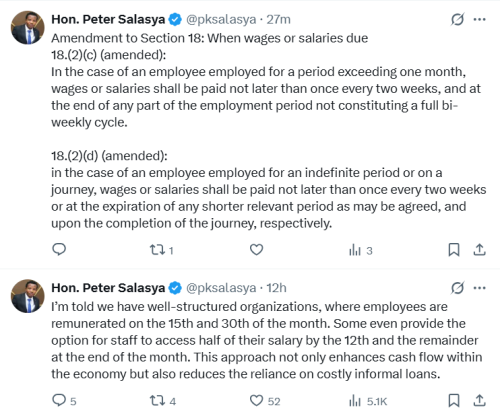
It introduces new payment schedules under revised clauses. According to Salasya, Section 18(2)(c) provides that “in the case of an employee employed for a period exceeding one month, wages or salaries shall be paid not later than once every two weeks, and at the end of any part of the employment period not constituting a full bi-weekly cycle.”
You Might Also Like



Section 18(2)(d) further states that “in the case of an employee employed for an indefinite period or on a journey, wages or salaries shall be paid not later than once every two weeks or at the expiration of any shorter relevant period as may be agreed, and upon the completion of the journey, respectively.”
Salasya noted that some well-structured organisations already pay staff on the 15th and 30th of the month or allow access to half salaries mid-month. He said such practices improve cash flow and reduce reliance on costly informal loans.
“I’m told we have well-structured organisations, where employees are remunerated on the 15th and 30th of the month. Some even provide the option for staff to access half of their salary by the 12th and the remainder at the end of the month. This approach not only enhances cash flow within the economy but also reduces the reliance on costly informal loans.”
Shrinking incomes
The debate over the proposed change comes against a backdrop of shrinking disposable incomes and rising taxes that are reshaping consumer and business behaviour. The private sector has voiced concern over Kenya’s growing “kadogo economy”, where products are increasingly sold in smaller, more affordable packets.
Carole Kariuki, CEO of the Kenya Private Sector Alliance, observed that manufacturers are now packaging goods such as sugar and maize flour in 1kg units instead of the previous 2kg, 5kg or 10kg sizes. She said many Kenyans, especially those in the middle class, are earning salaries comparable to those of seven years ago, which have been eroded by high taxes and living costs.
Salasya’s amendment seeks to address these structural shifts by improving workers’ finances and stimulating economic activity.
Author
Latest News








Advertisement
More on News