Safaricom explains how fraudsters are using Shiriki Pay to target M-PESA customers
By Mustafa Juma, July 27, 2026Safaricom has warned M-PESA users to remain vigilant against fraudsters exploiting the Shiriki Pay feature through social engineering tactics.
The telco says scammers are now increasingly manipulating unsuspecting customers into adding them as trusted beneficiaries before attempting to steal their money.
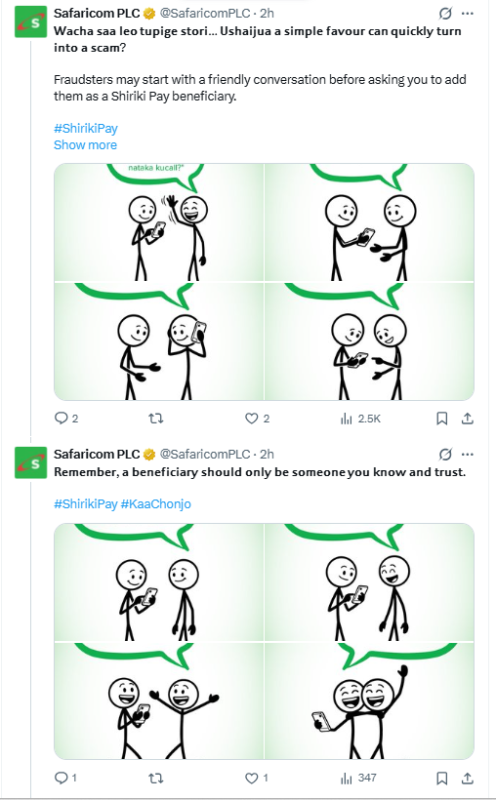
In a public advisory shared on its official X (formerly Twitter) account on Monday, July 17, 2026, Safaricom cautioned that what may begin as a harmless conversation or request for assistance could quickly escalate into a financial scam.
“Did you know a simple favour can quickly turn into a scam?” Safaricom said.
The company explained that fraudsters may first build trust with their targets before persuading them to register the scammers as Shiriki Pay beneficiaries.
Only add people you trust
Safaricom advised customers to exercise caution when using the feature, stressing that beneficiaries should only be individuals they personally know and trust.
“Remember, a beneficiary should only be someone you know and trust,” the company said.
The mobile service provider urged customers who receive suspicious requests to stop the transaction immediately, verify the person’s identity independently and report any suspected fraud through My OneApp or by sending an SMS to 333.
What is Shiriki Pay?
Shiriki Pay is an M-PESA feature that allows customers to authorise trusted family members or other individuals to access specified services or transact on their behalf under controlled conditions.
While the feature is designed to improve convenience for users who may need assistance managing their M-PESA accounts, fraudsters could attempt to abuse it through deception rather than by exploiting any technical weakness in the system.
The latest warning highlights the growing threat posed by social engineering, where criminals manipulate victims into voluntarily granting access or sharing sensitive information.
Rise in social engineering scams
Safaricom has repeatedly cautioned customers against scams that rely on human manipulation instead of hacking.
Such schemes often involve fraudsters pretending to be friends, relatives, customer care agents or business partners in an attempt to convince victims to reveal security credentials, approve transactions or make changes to their M-PESA settings.
In many cases, criminals first establish trust through prolonged conversations before introducing requests that appear genuine.
These scams succeed because victims believe they are helping someone they know rather than dealing with criminals.
How customers can stay safe
Safaricom has advised M-PESA users to:
- Only add Shiriki Pay beneficiaries they personally know and trust.
- Verify any unusual request independently before making changes to account settings.
- Never approve requests simply because someone appears friendly or claims to need urgent assistance.
- Report suspicious activity immediately through My OneApp or via SMS 333.
The company has continued strengthening its customer awareness campaigns as mobile money fraud evolves, urging users to treat every request involving access to their M-PESA accounts with caution.
Safaricom said customers should always pause and verify before acting, noting that a few moments of caution can prevent significant financial losses.