Advertisement
Ruto defends Kenya’s economic growth after KNBS’s report bombshell
Saturday 02nd May, 2026 12:22 AM|

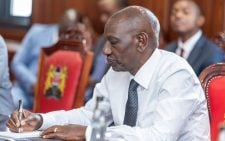
President William Ruto has defended his administration’s economic record following what he termed as misleading interpretations of the latest report by the Kenya National Bureau of Statistics (KNBS), even as new data fuels debate over the country’s slowing growth and deepening structural challenges.
Speaking during Labour Day celebrations in Vihiga on Friday, May 1, 2026, Ruto pushed back against what he described as alarmist headlines that followed the release of the 2026 Economic Survey.
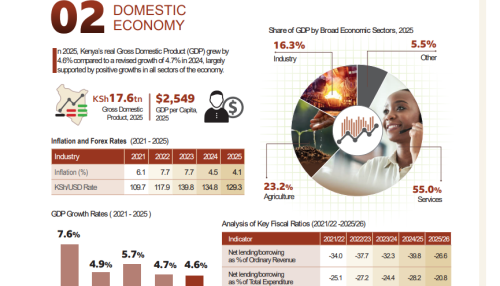
The report showed that Kenya’s economy expanded by 4.6 per cent in 2025, marking a second consecutive year of deceleration, from 4.7 per cent in 2024 and 5.7 per cent in 2023.
Despite the slowdown, the President insisted the broader trajectory remains positive. In nominal terms, Kenya’s GDP rose to Ksh17.6 trillion in 2025, up from Ksh16.2 trillion the previous year, with all sectors recording growth.
You Might Also Like

“Tunaweza kuwa na ripoti nyingi… lakini bei ya mbolea ilikuwa elfu sita sasa ni elfu mbili na mia mbili,” Ruto said, pointing to falling fertiliser prices and increased teacher recruitment as tangible indicators of progress.
He noted that over 120,000 teachers have been hired and framed such interventions as evidence that government policies are delivering real benefits beyond headline figures.
Ruto also said what he described as strong macroeconomic fundamentals. Foreign exchange reserves, he said, have risen to Ksh1.73 trillion, equivalent to nearly six months of import cover, while the Kenyan shilling has remained relatively stable at around Ksh129 to the US dollar for over two years. According to the President, this stability reflects improved investor confidence and sound policy management.
Govt scorecard?
He further defended the government’s employment record, citing flagship programmes such as the Affordable Housing initiative, which he said has created more than 640,000 jobs, with a target of one million.
Additionally, he noted that over 580,000 Kenyans have secured employment opportunities abroad, while revitalised sugar factories, from Nzoia to Mumias, Chemelil, Muhoroni, and Sony, are now operational and paying farmers and workers promptly.

However, the KNBS report paints a more nuanced picture, one that partly validates but also challenges the President’s narrative.
While the economy is indeed growing, the data confirms a clear loss of momentum. More critically, job creation remains heavily skewed toward the informal sector. Of the 822,100 jobs created in 2025, nearly 87 per cent were informal, highlighting the persistence of low-income and vulnerable employment.
This imbalance shows a deeper structural issue: although approximately 800,000 Kenyans enter the labour market each year, only about 100,000 secure formal employment. The rest are absorbed into informal activities, often characterised by low wages, limited protections, and minimal job security.
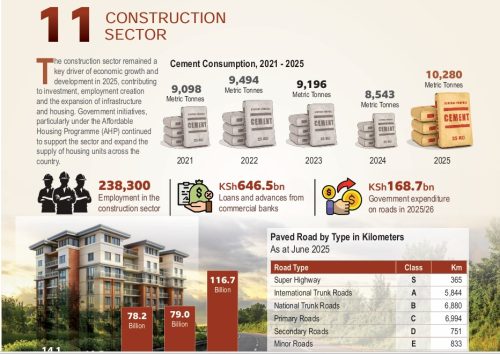
KNBS economic outlook
Beyond employment, the KNBS findings have intensified scrutiny over inconsistencies between official data and figures frequently cited by the President in public addresses.
For months, Ruto has leaned heavily on statistics to defend his economic agenda, emphasising recovery, productivity, and long-term stability amid widespread concerns over the high cost of living and rising taxes.
The latest report complicates that messaging, exposing gaps that risk eroding public trust in official communication, particularly at a politically sensitive time as the administration begins positioning itself ahead of the 2027 general election.
At the same time, the government appears to be recalibrating its fiscal strategy. Signals from the 2026 Budget Policy Statement (BPS) indicate a shift away from aggressive taxation toward policies aimed at boosting household incomes.

Proposals under consideration include reducing Pay As You Earn (PAYE) and expanding tax relief measures to increase disposable income.
This marks a notable departure from the Kenya Kwanza administration’s earlier approach, which prioritised expanding the tax base to finance development programmes. The shift reflects mounting pressure from households grappling with high living costs and stagnant wages.
The National Treasury has also invited public input on economic policy and tax measures for the 2026/27 financial year, signalling an effort to rebuild confidence and broaden participation in fiscal decision-making.
Yet the policy pivot presents a delicate balancing act. Treasury projections show that revenue demands will remain high even as the government aims to reduce the fiscal deficit from 5.3 per cent of GDP in 2026/27 to 3.3 per cent by 2028/29.
The Treasury insist this will be achieved through improved revenue collection, expenditure rationalisation, and protection of essential programmes.
Author
Latest News






Advertisement
More on News