Advertisement
RUPHA: Salaried Kenyans bear 96% of SHA burden
Monday 08th September, 2025 09:08 AM|

Salaried Kenyans, who make up less than 10 per cent of the population, are bearing 96 per cent of the financial burden of the Social Health Authority (SHA), exposing cracks in Kenya’s healthcare financing model.
This is according to the Rural and Urban Private Hospitals Association of Kenya (RUPHA) chairperson, Brian Lishenga, who has warned that the imbalance threatens to stall the country’s Universal Health Coverage (UHC) plans.
“SHA has been unable to raise enough money because it is relying heavily on the employed, so guys with the salary carry the burden of 96 percent of the SHA contribution yet, they only represent less 10 percent of the Kenuya’s population, this is the major problem at the core of our financial issues,” Lishenga explained during an interview with a local TV station on September 8, 2025.
The weight
SHA was launched in October 2024 to replace the National Health Insurance Fund (NHIF) and relies on a 2.75 per cent income-based contribution deducted directly from payslips. This has made employed Kenyans its primary contributors, despite their small numbers.
You Might Also Like


He added, “The informal sector are being told to register no one is telling them to contribute, so they are bringing in Ksh 600K monthly this is out of 25M Kenyans it is very litle amount of money, the salaried guys are bringing in almost Ksh 5.4B and they are only 3.4M people so, they are feeling the weight and they are not consuming the service because most of them have other insurances, so the model is a problem we need to look at.”
Unpaid claims
The informal sector, comprising over 80 per cent of Kenya’s 19.9 million-strong workforce, contributes minimally due to irregular incomes and weak enforcement. Of 18 million Kenyans registered under SHA, only 4 million actively pay, with 3.4 million salaried workers contributing Ksh 5.4 billion monthly compared to just Ksh600,000 from about 25 million informal workers.
The financial strain has spilled over to hospitals. On September 5, 2025, RUPHA issued a 13-day ultimatum to the government, demanding settlement of Ksh33 billion in NHIF arrears and Ksh43 billion in unpaid SHA claims. “Kenyan hospitals are on their knees. We need to remain open for our patients,” the association stated.
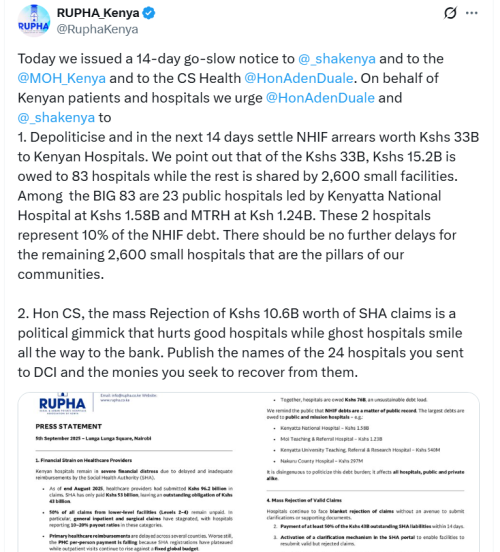
By August 2025, Ksh 96.2 billion in claims had been submitted, with only Ksh 53 billion settled. RUPHA pointed to irregularities such as Ksh 10.6 billion in rejected claims and payments made to defunct facilities like Sipili Maternity.
Calls for reform
The mounting crisis has drawn concern from stakeholders. The Kenya Medical Practitioners and Dentists Union has warned that SHA’s dependence on private hospitals, coupled with payment delays, risks destabilising healthcare delivery.
Former Roots Party deputy presidential candidate Justina Wamae also weighed in on September 7, posting on X: “Too much for funding Article 43. Creating wealth for the nation of Kenya is the ONLY agenda. Bigger than Wantam and Tutam shenanigans.”
“Unless reforms are implemented by enforcing contributions from the informal sector or boosting Exchequer support, Kenya’s universal healthcare goal remains at risk, with salaried workers carrying an unequal share of the load,” Lishenga noted.
Author
Latest News



Advertisement
More on News