Advertisement
RUPHA dismisses Ksh104B health digitisation amid fraud fears
Sunday 24th August, 2025 02:39 PM|

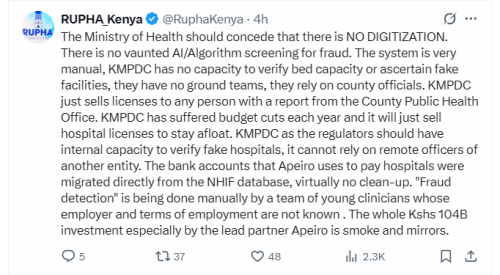
The Rural and Urban Hospitals Association of Kenya (RUPHA) has dismissed the Ministry of Health’s much-publicised Ksh104 billion digitisation programme as a sham, warning that the system is still manual and incapable of detecting fraud.
In a strongly worded statement issued on its official X account posted on Sunday, August 24, 2025, RUPHA said the Ministry of Health should concede that there is no digitalisation, describing the entire investment as “smoke and mirrors.”
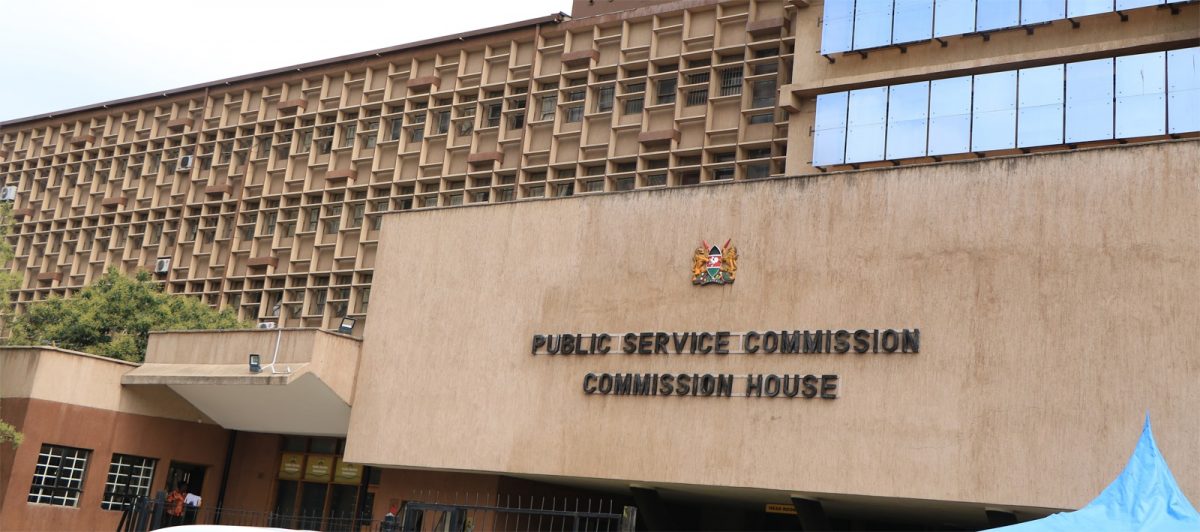
According to the association, the system being presented as a breakthrough in digital health is nothing but a manual process that has left the Kenya Medical Practitioners and Dentists Council (KMPDC) toothless. RUPHA slammed the regulator for lacking the ability to monitor hospital facilities, verify licenses, or weed out fake institutions.
“There is no vaunted Algorithm screening for fraud. The system is very manual, KMPDC has no capacity to verify bed capacity or ascertain fake facilities, they have no ground teams, they rely on county officials,” the statement read.
You Might Also Like


The hospitals’ association also claimed that licensing has become a survival tactic for the regulator, claiming that budget cuts had crippled its ability to function effectively. “KMPDC just sells licenses to any person with a report from the County Public Health Office. KMPDC has suffered budget cuts each year, and it will just sell hospital licenses to stay afloat,” RUPHA stated.
Loopholes
On fraud detection, RUPHA offered an even bleaker assessment, revealing that the so-called digitised monitoring system is being overseen by an unidentified team operating under opaque and questionable terms
“Fraud detection is being done manually by a team of young clinicians whose employer and terms of employment are not known,” the association said.
The association further raised alarm over the handling of sensitive financial data in the programme, pointing out that the bank accounts currently in use were migrated directly from the National Health Insurance Fund (NHIF) system without any scrutiny.
“The bank accounts that Apeiro uses to pay hospitals were migrated directly from the NHIF database, with virtually no clean-up,” RUPHA argued.
Ksh104 billion digitisation programme
The Ksh104 billion project was marketed as a futuristic health investment promising fraud-free hospital claims, real-time monitoring, and digitised patient services. But RUPHA’s statement suggests that the promise is far from reality, with the system still dependent on paperwork and verification by county-level officers.
“KMPDC, as the regulator, should have internal capacity to verify fake hospitals; it cannot rely on remote officers of another entity,” the association noted, questioning why a regulator of national repute would outsource oversight to county officials with limited capacity.
The claims strike at the core of Kenya’s ongoing battle to reform and rid its healthcare system of malpractice. Over the past decade, scandals involving ghost hospitals, fraudulent claims, and mismanagement at NHIF have eroded public trust. The government had promised that digitisation would end these loopholes, but RUPHA’s statement has reopened questions about the credibility of the reforms.
By terming the Ksh104 billion health digitisation programme as “smoke and mirrors,” RUPHA has thrown a spotlight on the Ministry of Health’s flagship investment, piling pressure on the government to demonstrate whether the project can actually deliver.
Author
Latest News



Advertisement
More on News