Advertisement
Revealed: Nairobi, Mombasa lead as Kenya’s protest hotspots
Friday 22nd May, 2026 11:02 PM|

Nairobi and Mombasa have emerged among Kenya’s leading protest hotspots as new findings reveal a sharp rise in demonstrations and deadly police crackdowns linked to civic unrest across the country.
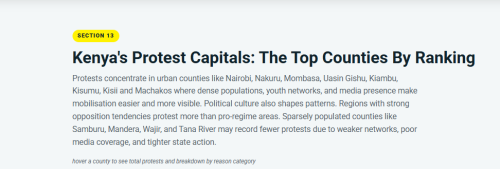
A new Kenya Freedom Index released on Friday, May 22, 2026, by Odipo Dev and Amnesty International Kenya identifies Nairobi, Nakuru, Mombasa, Uasin Gishu, Kiambu, Kisumu, Kisii and Machakos as the counties recording the highest concentration of protests between 2020 and 2025.
The report, which analysed 1,002 protests over the five years, says demonstrations are largely concentrated in urban counties due to dense populations, active youth networks and stronger media visibility.
“Protests concentrate in urban counties like Nairobi, Nakuru, Mombasa, Uasin Gishu, Kiambu, Kisumu, Kisii and Machakos where dense populations, youth networks, and media presence make mobilisation easier and more visible,” the report states.
You Might Also Like



The Kenya Freedom Index is described as the country’s first public platform dedicated to empirically tracking violations of the constitutional right to peaceful assembly.
Researchers compiled data from state agencies, civic organisations and media reports, including records from the Interior Ministry, the Kenya National Commission on Human Rights (KNCHR), the Independent Policing Oversight Authority (IPOA), ACLED and local and international media outlets.
The findings further suggest that political culture heavily influences protest patterns, with opposition strongholds recording more demonstrations than regions perceived as pro-government.
In contrast, counties such as Samburu, Mandera, Wajir and Tana River recorded fewer protests, a trend attributed to sparse populations, weaker mobilisation networks, limited media attention and what the report termed tighter state action.
Police killings
The release of the Freedom Index comes amid renewed concern over police brutality during demonstrations, particularly in Nairobi.

According to the Missing Voices Coalition’s 2025 annual report titled Unbowed for Justice, Nairobi recorded the highest number of alleged extrajudicial killings for the fourth consecutive year.
The report documented 125 police killings and six enforced disappearances across Kenya in 2025, with protest-related violence emerging as the dominant trigger for fatalities.
“Missing Voices recorded 125 cases of police killings and 6 cases of enforced disappearances from a total of 95 incidents in 2025,” the report states.
June and July, months marked by nationwide Gen-Z and Saba Saba protests, were identified as the deadliest period.
The coalition reported that 68 killings occurred during the two months alone, accounting for more than half of all deaths recorded in the year.
“The pattern where police killings spiked during periods of protest continued in 2025,” the report notes.
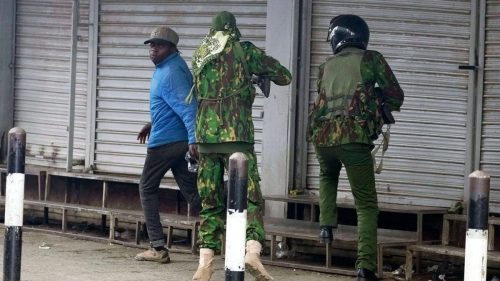
For the first time, anti-protest and crowd-control operations overtook anti-crime operations as the leading context in which police killings occurred.
Shootings accounted for the majority of deaths, with firearms linked to 114 cases.
The victims were overwhelmingly young men aged between 19 and 35 years.
“In all the years, the age group of 19–35 has suffered the highest number of casualties,” the report says.
Human rights groups say the trend exposes young urban men to heightened risk during police deployments and protest operations.

Despite fluctuations in national data, Nairobi remained the epicentre of claimed police violence.
“Since 2022, Nairobi has continuously ranked number one in the number of extrajudicial executions,” the report states.
Within the capital, Pangani Police Station was cited as recording the highest number of claimed executions, alongside Central Police Station, Kasarani, Villa and the Nairobi County Police Command.
Anti-riot police units deployed during demonstrations were also linked to the highest share of killings nationwide.
Rights groups say behind the statistics lie devastated families, shattered livelihoods and growing public concern over accountability within Kenya’s security agencies.
Author
Latest News







Advertisement
More on News