Advertisement
Proposal to merge secondary school science subjects faulted
Tuesday 17th May, 2022 01:30 AM|
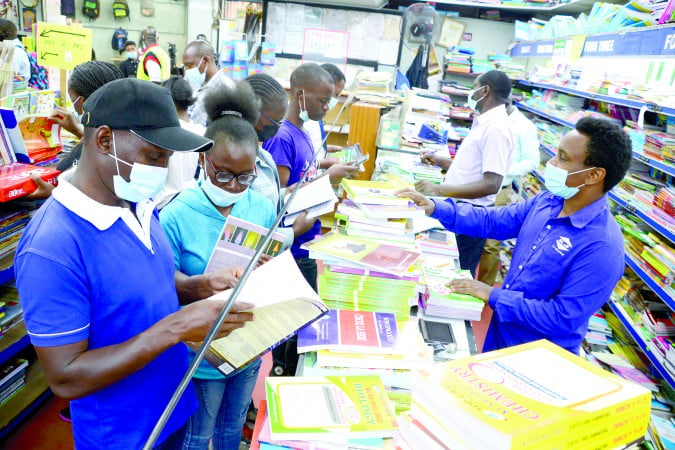
Some of the subjects taught in secondary schools could be merged under the Competency-Based Curriculum.
A training manual seen by People Daily indicates that some of the subjects being taught in secondary school and examined independently are likely to be merged with others, which could lead to accusations that the syllabus is being diluted.
For instance, science courses would be collapsed into one, combining Physics, Chemistry, Biology and General Science to form Integrated Science.
Environmental science, public health, personal hygiene and nutrition to be collapsed as Health Education.
You Might Also Like

Pre-technical and Pre-Career Education teachers will handle Woodwork, Metalwork, Technical Drawing, Electricity, Electronics, Home Management, Typewriting, Shorthand, Textiles and Clothing, Auto Mechanics and Accounting.
Sign language
Core learning subjects in junior secondary schools would be English, Kiswahil, Mathematics, Agriculture, Home Science, Social Studies, Art and Craft, Music, Science and Technology, Religious Education and Physical Health Education.
“Collapsing all the science subjects into one called Integrated Science is diluting science subjects. You don’t expect a teacher handling the subject to be as comprehensive as it is presently,” says Jonathan Wesaya, a trained teacher and an expert on public policy
Kenya Sign Language, Indigenous languages, French, Arabic, German and Chinese would remain optional.
Experts have also raised questions about the apparent rush by the government in training teachers on the Competency-Based Curriculum (CBC).
Training of trainers
Educationists are now comparing the training of teachers on CBC to one conducted in 2014 when the government was implementing the botched laptop project.
Under the scheme, the government selected a few teachers who were expected to pass on the skills and knowledge acquired in the training to other colleagues.
At the end of the training, those who had been identified found themselves isolated in schools and unable to pass the skills to their colleagues under the scheme of training-of-trainers.
Last week, the government organised a six-day training session targeting about 60,000 teachers from public and private schools. “Teachers Service Commission (TSC) has planned the above-stated training in each sub-county between May 9 -12, 2022.
You are required to request all heads of both public and private secondary schools to release six teachers identified in 6 areas to attend the training,” says a letter by Nzuvu Nzioka, the TSC Kakamega county director.
In the letter addressed to all the TSC sub-county directors, Nzioka discloses that teacher participants would, besides being reimbursed Sh400 for transport for four days, would also be provided with lunch and two tea sessions at a cost of Sh500 per day and Sh100 once for stationery.
Private institutions were to pay Sh500 to the training centres for lunch each as well as provide transport for their members.
According to the 2021 Economic Survey, eight out of 10 teachers are yet to acquire the requisite qualifications for teaching CBC.
The report indicated 178,024 teachers or 81.6 per cent held the P1 certificate by the end of last year yet they require a diploma to effectively implement the new curriculum.
They will need to upgrade their qualifications through a one-year in-service programme at Teacher Training Colleges.
Author
Mathew.Ndungu
View all posts by Mathew.NdunguLatest News




Advertisement
More on News