Advertisement
Babu Owino questions Sakaja’s Ksh1.18B domestic travel costs
Monday 29th June, 2026 12:28 PM|

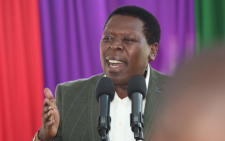
Embakasi East MP Babu Owino has criticised Nairobi Governor Johnson Sakaja over rising county travel expenditure after a Controller of Budget report revealed Nairobi spent Ksh1.18 billion on domestic travel in the first nine months of the 2025/26 financial year.
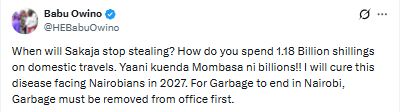
In a post published on his X account on Monday, June 29, 2026, Owino questioned the scale of the spending and linked it to wider concerns about service delivery in Nairobi.
“When will Sakaja stop stealing? How do you spend 1.18 billion shillings on domestic travel? Yaani kuenda Mombasa ni billions!!” Owino wrote.
He added: “I will cure this disease facing Nairobians in 2027. For garbage to end in Nairobi, garbage must be removed from the office first.”
You Might Also Like


The remarks followed the release of the County Governments Budget Implementation Review Report by the Office of the Controller of Budget, led by Margaret Nyakang’o. The report showed that Nairobi County recorded one of the highest travel expenditures among the 47 counties.
According to the report, Nairobi spent Ksh1.18 billion on domestic travel and a further Ksh373.61 million on foreign travel during the review period. The combined travel bill pushed the county’s total spending on trips and related activities to more than Ksh1.5 billion.
The Controller of Budget report also revealed that counties across Kenya spent a combined Ksh13.17 billion on domestic and foreign travel between July 2025 and March 2026. The findings triggered debate about public finance management, especially as many counties continue to struggle with stalled development projects, pending bills, and underfunded services.
Owino used Nairobi’s spending figures to attack Sakaja’s administration, arguing that the county continues to face serious service delivery problems despite the high expenditure.
Growing pressure over spending
The Embakasi East MP pointed to Nairobi’s ongoing garbage collection crisis, which has remained a major political issue in the capital. Several estates across the city have repeatedly complained about delayed waste collection, blocked drainage systems, and poor sanitation.
His comments also come at a time when political rivalry within Nairobi is growing ahead of the 2027 General Election. Owino has increasingly positioned himself as a critic of the Nairobi County government and hinted at a possible larger political role in the city.
The Controller of Budget report paints a broader picture of growing recurrent expenditure in counties. Besides travel costs, the report showed that many county governments continue to spend heavily on salaries, allowances, operations, and meetings while development spending remains low.
Critics argue that counties should prioritise health services, roads, markets, water projects, and waste management instead of increasing travel and operational budgets.
Narok Senator Ledama Olekina also questioned the Controller of Budget on the same day over county travel expenditure. In an open letter, he asked whether the office was approving withdrawals that were not properly supported by law under Article 228(5) of the Constitution.
The debate has renewed calls for stronger oversight of county spending and tighter controls on recurrent expenditure. Public finance experts say county assemblies and oversight agencies must demand greater accountability to ensure public funds support development and essential services.
Author
Kenneth Mwenda
Kenneth Mwenda is a business, sports, and politics digital writer with over seven years of experience in journalism, covering breaking news, feature stories, and in-depth analysis across a range of beats.
For inquiries, he can be reached at [email protected]
View all posts by Kenneth MwendaLatest News






Advertisement
More on Inside Politics