Advertisement
Private sector’s role in efforts to heal ozone layer
Friday 16th September, 2022 02:19 AM|
In 1994, the UN General Assembly proclaimed 16 September the International Day for the Preservation of the Ozone Layer.
This year marks its 35th anniversary, providing a platform for us to reflect on the progress made towards replenishing the ozone layer.
To understand the role of the private sector in the journey towards healing of the ozone layer we need to, firstly, understand what the ozone layer is, and why is it important.
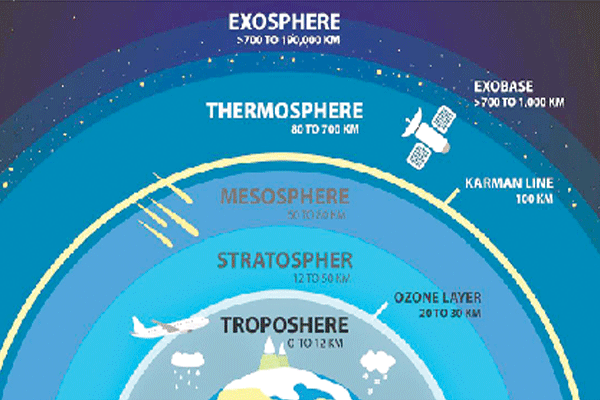
The ozone layer is the part of the Earth’s atmosphere which contains relatively high concentrations of ozone gas, which is an inorganic molecule with the chemical formula O3. It absorbs most of the ultraviolet radiation reaching the earth from the sun thereby protecting the Earth from harmful ultraviolet (UV) rays from the sun.
Without the Ozone layer in the atmosphere, life on Earth would be very difficult. Plants cannot live and grow in heavy ultraviolet radiation, nor can the planktons that serve as food for most of the ocean life.
The emission of dangerous gases such as CFCs (chlorofluorocarbons) has caused the formation of holes in the ozone layer leading to higher radiations reaching the earth’s surface. The increased radiation cause negative effects on human health through causing increases in certain types of skin cancers, eye cataracts and immune deficiency disorders.
The radiation also affects terrestrial and aquatic ecosystems, altering growth, food chains and biochemical cycles. This has potential to prominently reduce agricultural productivity. Scientists and researchers have concluded that with these extremely adverse side effects happening, earth will be unbearable for any life form – both aquatic and terrestrial, animal and plants.
We, therefore, have the responsibility to protect the balance in the planet forces and prevent any imbalances that could lead to detrimental results. All stakeholders need to unite and co-operate toward change.
This is the very purpose of this year’s theme: Global Co-operation – Protecting Life on Earth, which emphasizes on the need to forge partnerships and develop global cooperation to address ozone depletion and protect life on earth.
In light of this, it is important for individual countries to build cohesion within themselves – unifying the government and private sector – to provide stronger contributions to global challenges such as the depletion of the ozone layer.
The teamwork between governments and private sector players is needed, for example, to phase out the use of ozone-depleting gases, some of which are used in modern cooling systems such as air conditioners and refrigerators.
Governments should establish policies while the private sector can finance green innovations, plant trees to enhance the absorption of carbon emissions, adopt ozone-friendly technologies and ratify the Montreal Protocol and the recently proposed, Kigali Amendment.
At Kenya Breweries Limited (KBL), we are committed to caring for the environment. This is by minimising industrial pollution, adopting new environmental-friendly technologies and promoting sustainable management of forests.
We have invested Sh3.6 billion in two Biomass steam plants in Nairobi and Kisumu. The plants consist of four biomass boilers and officially began operating in June 2022. They have replaced heavy fuel oil (HFO) using sustainable fuel alternatives like macadamia shells, rice husks, coffee husks, and sugar bagasse to generate steam power for the breweries. As a result, we will reduce our carbon emissions by 95 per cent (34,000 tonnes) per year.
We also partnered with a leading technology provider to connect our beer refrigerators to the internet. The fridges contain sensors that leverage the internet of things (IoT) and can transmit real-time data on usage patterns and temperature levels. This allows for predictive maintenance since problems are detected early, preventing breakdown, which may lead to the escape of dangerous gases from the appliances.
The Internet of Things (IoT) also ensures that we minimize equipment downtime and allows for temperature adjustments depending on customers’ requirements and the local climatic conditions. This partnership, therefore, helps to conserve the energy used to run our commercial refrigeration equipment.
Finally, we have collaborated with various organizations to promote the restoration of degraded forests. Through these partnerships, we have planted and nurtured over one million trees, with over 320,000 trees having been planted between 2017 and 2021, with an overall strong success rate of 85 per cent. Some of our partners include Nature Kenya, Kenya Forest Service, Friends of Karura Forest, Community Forest Associations and Lake Basin Development Authority.
In March, we provided financial support to the tune of Sh5 million to the Upper Tana Nairobi Water Fund. The funds will go towards increasing forest coverage by planting and nurturing three million trees by 2026.
Sustainable business models are needed to protect life on earth – the lives of living things as well as the lifecycle of businesses.
We are proud of our contribution to environmental sustainability and appreciate the partners that have helped us achieve this.
—The writer is KBL operations director
Author
PD columnist
View all posts by PD columnistLatest News








Advertisement
More on News