Advertisement
Police commit to fighting sexual and gender-based violence
Wednesday 11th February, 2026 03:18 PM|

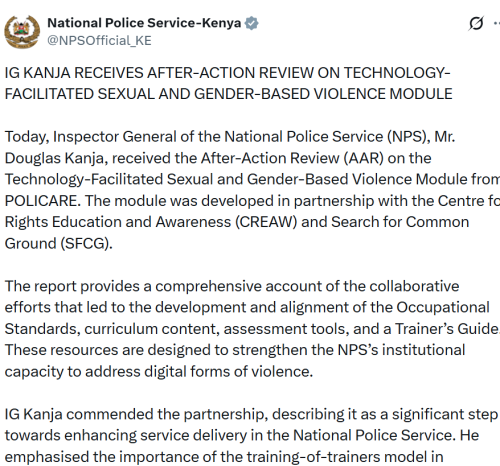
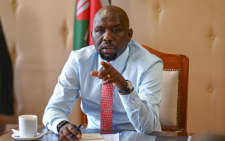
Inspector General of Police Douglas Kanja has promised that the service is devoted to continuing the fight against sexual and gender-based violence
Speaking after receiving the After-Action Review (AAR) on the Technology-Facilitated Sexual and Gender-Based Violence Module from POLICARE on Wednesday, February 11, 2026, Kanja has commended the collaboration between the National Police Service (NPS) and the Centre for Rights Education and Awareness (CREAW) and Search for Common Ground (SFCG). He has noted that this collaboration has helped the Police Service in its dedication to coordinating and reinforcing efforts for the response to and prevention of sexual and gender-based violence
In a statement on Wednesday, February 11, 2026, NPS noted that the module submitted to the IG was developed in partnership with the Centre for Rights Education and Awareness (CREAW) and Search for Common Ground (SFCG).
“IG Kanja commended the partnership, describing it as a significant step towards enhancing service delivery in the National Police Service. He emphasised the importance of the training-of-trainers model in advancing the NPS’s commitment to service excellence. He highlighted that security is a shared responsibility, with the police serving as the primary providers,” NPS stated.
You Might Also Like

NPS further noted that the report provides a comprehensive account of the collaborative efforts that led to the development and alignment of the Occupational Standards, curriculum content, assessment tools, and a Trainer’s Guide.
These resources are designed to strengthen the NPS’s institutional capacity to address digital forms of violence.
The National Police Service has reiterated its dedication to coordinating and reinforcing efforts for the response to and prevention of sexual and gender-based violence.
According to the Kenya National Commission on Human Rights (KNCHR, approximately 207 cases of gender-based violence between the years 2017 and 2024, excluding the cases of electoral-related GBV (2017 and 2022), were reported during the period. At least 57.4% of the complainants are female, and 40.7% are male, with the youth (18-34 years) being the most affected age group. The Commission has received the highest number of complaints in Nairobi and Kisumu counties, and the lowest number of complaints from Marsabit county.

GBV is more often than not used as a tool to maintain and reinforce gender power imbalance. It manifests in various forms, including but not limited to sexual violence, including rape, defilement, sexual harassment and exploitation, intimate partner violence, economic abuse through control of one’s access to financial resources, emotional and psychological violence through intimidation, harassment and verbal abuse and harmful traditional practices such as female genital mutilation, early and forced marriages.
Author
Latest News








Advertisement
More on News