Advertisement
Parliament seeks to revamp Posta Kenya
Wednesday 08th October, 2025 12:06 PM|

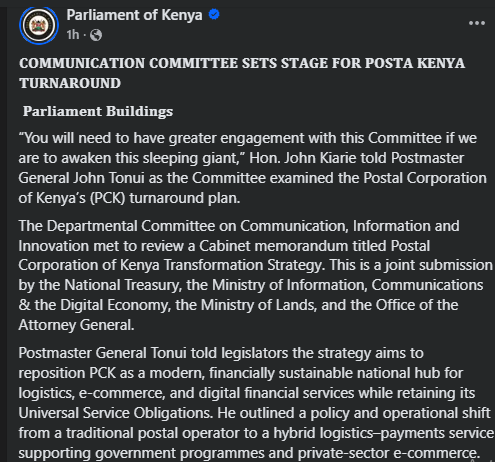
The Parliamentary Communication Committee is putting measures in place for the turnaround of the state communication firm, Postal Corporation Kenya.
On Wednesday, October 8, 2025, the Departmental Committee on Communication, Information and Innovation met to review a Cabinet memorandum titled Postal Corporation of Kenya Transformation Strategy.
This is a joint submission by the National Treasury, the Ministry of Information, Communications & the Digital Economy, the Ministry of Lands, and the Office of the Attorney General.
In the meeting, Postmaster General Tonui told legislators the strategy aims to reposition PCK as a modern, financially sustainable national hub for logistics, e-commerce, and digital financial services while retaining its Universal Service Obligations.
You Might Also Like



He outlined a policy and operational shift from a traditional postal operator to a hybrid logistics–payments service supporting government programmes and private-sector e-commerce. The Committee was briefed on PCK’s liabilities amounting to about Ksh7.2 billion, including salary arrears (Ksh405 million), unremitted pensions (Ksh463 million), supplier debt (Ksh1.5 billion), and a Communication Authority liability of Ksh196 million, among others.
While members acknowledged that the strategy rests on sound pillars, they stressed that disciplined execution and tight governance would determine its success. Lawmakers affirmed their commitment to match support with oversight to ensure delivery.
Breathing new life
Practical ideas emerged on how Posta’s vast footprint can generate immediate public value and revenue. Members proposed reinstating Posta as a reliable payment channel for national programmes such as Inua Jamii to enhance convenience for beneficiaries and create a steady transactional income stream.
The lawmakers also suggested integrating PostaPay (digital money orders) with the Ministry of Education’s capitation payments to schools and using PCK’s channels to distribute NGCDF bursary funds. This, they noted, would reduce delays and leakages while leveraging Posta’s national network.
Beyond near-term gains, the Committee recommended structural and governance measures to restore financial health, including commissioning an independent forensic and financial audit, prioritising statutory obligations such as pensions and PAYE, accelerating digitisation of core revenue services, and pursuing public–private partnerships for last-mile logistics and e-commerce fulfilment. Members also called for a human-centred approach to any staff restructuring, with clear communication and safeguards for workers.
“We want Posta to succeed, but success must be measurable, timely, and accountable,” Committee member Kiarie said in closing. The Committee urged the transformation to focus on quick wins that stabilise finances, paired with medium-term investments in technology and partnerships to secure long-term growth.
Author
Latest News





Advertisement
More on News