Olekina demands answers over rapid emergency fuel import approvals
By Kenneth Mwenda, April 16, 2026Senator Ledama Olekina has raised fresh questions over Kenya’s recent fuel supply crisis, pointing to what he calls suspicious speed in emergency fuel imports and possible coordination behind the shortage.
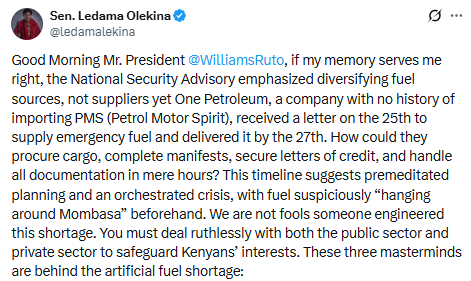
In a post on X on April 16, 2026, Olekina questioned how One Petroleum, a company with no known record of importing Premium Motor Spirit (PMS), was able to secure an emergency supply letter on March 25 and deliver fuel by March 27.
He asked how the firm managed to arrange cargo, complete shipping documents, secure letters of credit and handle other formalities within such a short time.
“This timeline suggests premeditated planning and an orchestrated crisis, with fuel suspiciously ‘hanging around Mombasa’ beforehand,” he wrote.
Olekina named officials he said should answer for the process, including Kenya Pipeline Company (KPC) deputy managing director Joel Mburu, Energy Ministry official Joseph Wafula, and One Petroleum representative Mohammed Jeffer. He also said former Petroleum Principal Secretary Liban had been “collateral damage” in the matter.
The senator’s remarks came as the Senate Energy Committee continued hearings into the fuel disruption, which triggered shortages and price concerns in parts of the country.
The Kenya Ports Authority (KPA) presented a detailed timeline for the MT Paloma shipment, which carried 60,200.813 metric tonnes of PMS. The vessel arrived at outer port limits on March 27 at 2:30 am. It berthed later that evening at 20:42 hours at KOT II, berth No. 1. Discharge ended on March 30 at 12:12 pm, and the vessel left the port at 19:20 hours after clearance.
Fuel quality under scrutiny
Senators questioned fuel quality controls and oversight. Senator Veronica Maina warned, “We should stop substandard products from passing through the Kenya Pipeline system.” She asked what safeguards existed to prevent contaminated fuel from entering the system. Senator Mungatana said Kenya needed a stronger laboratory testing capacity instead of relying mainly on paperwork.
Energy officials said 19 tankers were handled between March 1 and April 12 without congestion at the port, citing Kipevu Oil Terminal II capacity.
The crisis began after a Government-to-Government (G2G) supply from Dubai failed to depart due to Middle East tensions. Authorities then invited private firms to fill the gap.
One Petroleum delivered its cargo on MT Paloma at a landed cost of about Ksh198,855 per metric tonne. Energy Cabinet Secretary Opiyo Wandayi later ordered the fuel withdrawn, saying it was too expensive compared to G2G imports priced at about Ksh140,000 per metric tonne. The government said the higher cost could have pushed pump prices up by about Ksh14 per litre.
One Petroleum complied and confirmed the fuel would not enter the market.
Oryx Energies Kenya also lost a similar deal after the government cancelled its emergency import despite approvals already issued. Managing Director Angeline Maangi told senators, “The company acted at the government’s request, under extreme market conditions, and with the sole purpose of supporting Kenya’s energy security.” The firm claims losses of Ksh3.2 billion.
Investigators now say officials may have manipulated stock data to create an artificial shortage. Several senior officials have resigned or been questioned as the probe continues.
President William Ruto has defended the G2G model, saying it protects Kenya’s energy security. The Senate committee is now focusing on pricing, regulation, and whether the crisis was engineered.