Advertisement
Ndindi Nyoro questions Ruto’s economic growth claims amid weakening Kenyan shilling
Tuesday 25th November, 2025 06:42 PM|
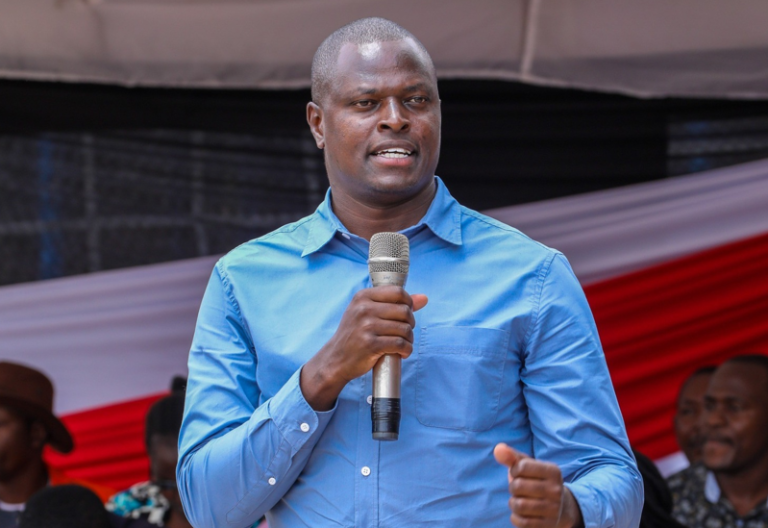
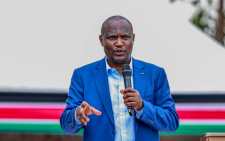
Kiharu Member of Parliament Ndindi Nyoro has questioned President William Ruto’s claims on Kenya’s economic performance, pointing to conflicting data on the shilling, stock exchange, and public spending.
Speaking in Parliament on November 25, 2025, Nyoro argued that the facts do not match the optimistic picture painted in the President’s speeches.
“I will be direct to the point,” Nyoro said. “When we listen to the State of the Nation address, data should speak more than words. If you want to invest in a company, for example, you rely on financial statements verified by regulators like the Capital Markets Authority and the Central Bank of Kenya.”
“That data is believable. But some of the data presented last week was incorrect. I don’t know whether it is the Kenya National Bureau of Statistics that is wrong or those delivering the speech who didn’t have the correct data.”
You Might Also Like


Nyoro cited the exchange rate as the first example.
“During elections in Kenya, the exchange rate to the US dollar was 118 shillings. On the day of the swearing-in, it was 120 shillings. In 2023, it reached 159 shillings. The shilling has actually depreciated by 8.5 per cent from August 2022, while the US dollar itself has depreciated by 10 per cent globally. So, which data is correct?”
Nyoro’s concerns are echoed by international observers. The International Monetary Fund (IMF) has expressed unease over Kenya’s shilling stability, arguing that the limited fluctuation may affect monetary policy and inflation targeting.

The currency has hovered around Ksh129 per dollar for most of 2025, supported by strong reserves and diaspora remittances, but the Fund has questioned whether such stability reflects the true dynamics of the economy.
He also criticised the President’s remarks about the Nairobi Securities Exchange.
“The speech claimed the NSE is at an all-time high. That is incorrect. The NSE 20 Share Index saw its highest point in 2017, not now. The broader All Share Index also peaked in 2017. Stock exchanges are measured by indices, not by market capitalisation alone.”
Nyoro went further to highlight issues in the construction sector.
“According to the Kenya National Bureau of Statistics, the construction sector contracted by 2 per cent in 2024. Cement consumption fell by 7.9 per cent. Even with housing projects ongoing, activity has slowed. Data speaks for itself.”
He compared economic growth across administrations.
“Over the past three years under President Uhuru Kenyatta, Kenya’s GDP rose from Ksh19 billion to Ksh26 billion, a 36 per cent increase. Under the current administration, growth has been around 14 per cent. If you grade, the past three years of the previous administration scored 72 per cent, while the current administration is at 29 per cent.”
Nyoro: Kenya’s growth trails neighbours
Nyoro also pointed out that Kenya’s growth lags behind its East African neighbours.
“In 2024, Uganda’s economy grew by 6 per cent, Tanzania by 6.1 per cent, and Rwanda by over 8 per cent. Kenya, by contrast, grew by only 4.7 per cent. Facts are like lions; you release them, and they defend themselves.”
Nyoro also addressed public debt.
“Kenya is borrowing 3.5 billion shillings every day. There is also borrowing through securitisation and other mechanisms. These are monumental issues that deserve public attention, yet they were not highlighted in the speech.”
The MP did not limit his remarks to economic matters. He criticised the government’s education policies.
“The Ministry of Education has sent a circular reducing capitation per student from 22,000 shillings to 12,000 shillings in day secondary schools. This will force parents to pay an extra 9,300 shillings on top of school levies. Some families cannot even afford 1,000 shillings per term. We must not allow this to happen.”
Nyoro urged the government to uphold free basic education.
“Instead of slashing capitation, the government should increase it to match the cost of living. Free education is a right. Leaders must prioritise education over politics.”
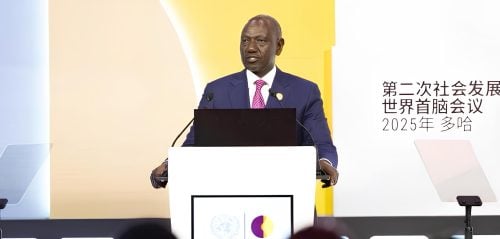
His remarks came after President Ruto has severally claimed that Kenya had overtaken countries like Ethiopia and Angola to become the sixth-largest economy in Africa.
“By God’s grace, Kenya has passed countries like Ethiopia and Angola,” Ruto said in Qatar on November 4, 2025.
He also repeatedly highlighted what he described as improvements in key economic indicators. According to Ruto, inflation had fallen from 9.6 per cent three years ago to 4.6 per cent, while the shilling had strengthened from 165 to around 128 against the US dollar
Author
Kenneth Mwenda
Kenneth Mwenda is a business, sports, and politics digital writer with over seven years of experience in journalism, covering breaking news, feature stories, and in-depth analysis across a range of beats.
For inquiries, he can be reached at [email protected]
View all posts by Kenneth MwendaLatest News

Advertisement
More on News