Advertisement
NASA discovers starless relic cloud dominated by dark matter
Tuesday 06th January, 2026 12:12 AM|
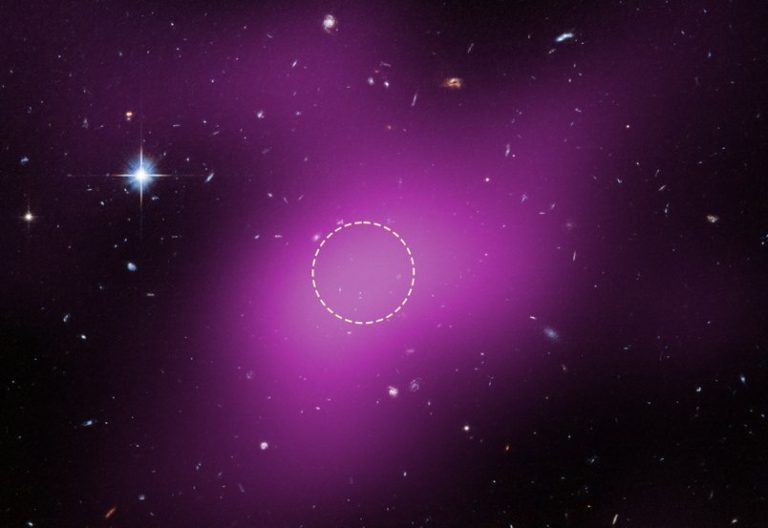
NASA’s Hubble Space Telescope has confirmed the existence of a starless astronomical object known as Cloud-9, marking the first detected example of a Reionization-Limited H I Cloud (RELHIC).
The cloud, composed primarily of neutral hydrogen gas and dominated by dark matter, represents a relic from the early stages of galaxy formation.
Cloud-9 is situated approximately 14 million light-years from Earth, near the spiral galaxy Messier 94 (M94). The cloud was initially detected three years ago through a radio survey conducted by China’s Five-hundred-meter Aperture Spherical Telescope (FAST).
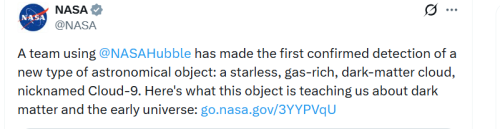
“A team using @NASAHubble has made the first confirmed detection of a new type of astronomical object: a starless, gas-rich, dark-matter cloud, nicknamed Cloud-9. Here’s what this object is teaching us about dark matter and the early universe,” NASA stated in an X post dated January 5, 2025.
You Might Also Like

Subsequent confirmations were made using the Green Bank Telescope and the Very Large Array (VLA) in the United States. High-resolution radio observations revealed slight distortions in the gas, suggesting a physical interaction with M94.
“The core of the cloud, composed of neutral hydrogen, measures approximately 4,900 light-years in diameter,” NASA reported.
Radio data indicate that the hydrogen gas has a mass equivalent to about one million times that of the Sun. Based on the balance between gas pressure and gravitational forces, calculations estimate the dark matter content at roughly five billion solar masses.
Hubble imaging shows no stars
Optical imaging from Hubble’s Advanced Camera for Surveys provided crucial confirmation, revealing no stars within Cloud-9’s boundaries. The few visible objects in the region are background galaxies. This absence of stars distinguishes the cloud from typical dwarf galaxies and confirms its classification as a RELHIC, a primordial structure that accumulated insufficient gas to trigger star formation.
Unlike larger hydrogen clouds observed near the Milky Way, Cloud-9 is compact, highly spherical, and smaller in scale. Its survival as a starless entity highlights conditions in the early universe where certain dark matter halos retained neutral hydrogen but failed to collapse into stars.
Environmental factors, such as ram-pressure stripping during motion through intergalactic space, contribute to the rarity of such objects today. Nearby bright sources also make detection challenging. Cloud-9 was named sequentially as the ninth gas cloud identified near M94.
Implications for galaxy formation and dark matter
The discovery supports theoretical models predicting dark matter-dominated structures that represent failed galaxies. NASA noted that future surveys may identify additional RELHICs, providing further insight into galaxy evolution and the properties of dark matter.
The findings were published in The Astrophysical Journal Letters and presented at the 247th meeting of the American Astronomical Society. Hubble, a joint project of NASA and the European Space Agency, continues to operate more than three decades after its launch, with operations managed by NASA’s Goddard Space Flight Center and science activities conducted by the Space Telescope Science Institute.
Author
Latest News








Advertisement
More on News