Murkomen directs police to prioritise training and counselling on use of force
By Aloys Michael, July 18, 2025Interior Cabinet Secretary Kipchumba Murkomen has issued a landmark policy directive aimed at reforming the use of force and firearms by the National Police Service (NPS).
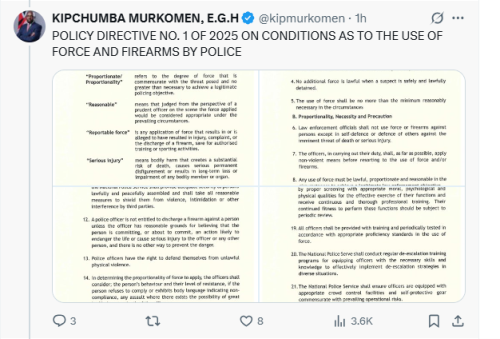
The directive released on Friday, July 18, 2025, on his X account, highlights rigorous training, counselling, and strict accountability mechanisms as core pillars to ensure law enforcement officers act within constitutional and ethical boundaries.
This directive marks a critical step toward reforming law enforcement practices in Kenya with a renewed focus on training, mental wellness, accountability, and the protection of all citizens’ rights.
Titled Policy Directive No. 1 of 2025 on The Use of Force & Firearms, the directive sets clear guidelines for police officers on exercising restraint, especially when interacting with vulnerable groups such as children, persons with disabilities, older persons, and gender-based vulnerable groups.
Murkomen stressed that all interventions remain sensitive, proportionate and non-discriminatory.
A significant focus of the directive is on the continuous professional development of police officers. It mandates that officers deployed in law enforcement be selected through rigorous screening processes that assess their moral, psychological, and physical fitness.
“Their continued fitness to perform these functions should be subject to periodic review,” the directive states.

Training will be ongoing, and officers will be periodically tested against proficiency standards specific to the use of force.
“The NPS will conduct regular de-escalation training programs for equipping officers with the necessary skills and knowledge to effectively implement de-escalation strategies in diverse situations,” reads the statement.
Additionally, the policy requires the National Police Service to provide officers with adequate crowd control tools and protective gear tailored to operational risks.
Murkomen directed the NPS to prioritise ethics, mental health, human rights, and peaceful conflict resolution in its training curriculum.
The directive encourages alternatives to the use of force, such as persuasion, negotiation, and mediation, to reduce firearm deployment. Counseling services will also be made available to officers involved in incidents where force is applied, acknowledging the psychological impact of such encounters.
The directive promotes a culture of responsibility within the police service, expecting officers to “account for their actions while recognising the challenges inherent in operational policing.”
Officer screening, legal action
To ensure due process, officers accused in connection with use-of-force incidents will receive legal representation arranged in coordination with the Office of the Attorney-General.
The policy reinforces collaboration with the Independent Policing Oversight Authority (IPOA) to guarantee “objective review and analysis of all incidents of reportable force,” alongside regular consultations to maintain accountability.
Qualified personnel from the Directorate of Criminal Investigations (DCI) will be embedded within investigative teams to ensure timely and impartial inquiries. Officers involved in use-of-force incidents are entitled to independent investigations under IPOA regulations and must cooperate fully with investigations and proceedings.
To enhance transparency, the directive mandates the use of modern technology such as fixed closed-circuit television (CCTV) systems, body-worn cameras, and other digital evidence tools. These technologies aim to safeguard the integrity of investigations and improve public trust.
Furthermore, the National Police Service will establish measurable Key Performance Indicators (KPIs) and maintain a centralised data system tracking reportable force incidents, public complaints, and training completion rates.
Special care is emphasised when applying force in sensitive contexts. Officers are instructed to exercise heightened caution, ensuring that any use of force is lawful, necessary, and proportionate, especially with vulnerable populations.
The directive also mandates the protection of peaceful protesters from violence or interference, per constitutional rights.
The CS emphasised that the directive’s overarching goal
“To foster a police culture rooted in professionalism, transparency, and respect for human rights, ensuring that the use of force is always a measure of last resort and carried out responsibly.”