Advertisement
MPs grill Energy PS over near-doubling of electricity grid project budget
Thursday 07th August, 2025 08:23 PM|

Energy Principal Secretary Alex Wachira was taken to task by members of the Public Debt and Privatisation Committee over the steep increase in the cost of the National System Control Centre (NSCC) electricity grid project.
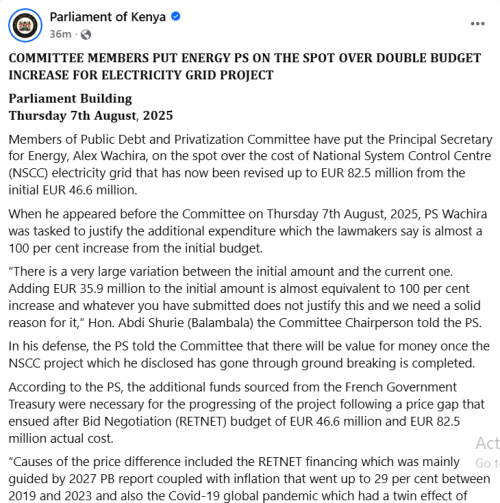
The lawmakers, on Thursday, August 7, 2025, raised concern after it emerged that the project budget had ballooned from the initial Ksh6.5 million to Ksh11.5 million, a near 100 per cent increase.
“There is a very large variation between the initial amount and the current one,” said Committee Chairperson Abdi Shurie (Balambala). “Adding 5 million to the initial amount is almost equivalent to a 100 per cent increase, and whatever you have submitted does not justify this. We need a solid reason for it.”
Inflation blamed
In his defense, PS Wachira told the committee that the additional funding was necessary to bridge the gap between the initial Bid Negotiation (RETNET) budget and the actual project cost.
You Might Also Like



“Causes of the price difference included the RETNET financing, which was mainly guided by the 2027 PB report, coupled with inflation that went up to 29 per cent between 2019 and 2023, and also the Covid-19 global pandemic, which had a twin effect of destabilising global macroeconomics and creating a level of risk attracting hedging,” Wachira said.
He added that the new budget was approved in collaboration with the French Government Treasury, which is funding the project. The PS also argued that despite the increase, the country would get value for money once the project is completed.
“The NSCC project has already undergone groundbreaking, and once finalised, it will greatly improve the efficiency and reliability of Kenya’s electricity grid,” he said.
Project timelines adjusted
Wachira further explained that the original project timelines were compressed to meet sector demands, which also contributed to the cost adjustments. Initially projected to take up to 48 months, the implementation period was reduced to 36 months.
“This shorter completion timeline has cost implications, but it was necessary to align with current energy sector requirements,” he said.
The committee also heard that the project scope had expanded significantly following a review of the initial plan. Wachira revealed that the revised design included a floor area increase of more than double, installation of advanced wastewater management systems, enhanced physical security features, upgraded infection control and sanitary requirements, and improved internal finishing standards.
Following the session, the committee directed the PS and his team to furnish the members with a detailed report justifying the revised budget before any further consideration of the funding request.
Author
Latest News





Advertisement
More on News