Advertisement
Moses Kuria explains deep economic ties between Somalia and Kenya
Saturday 24th January, 2026 06:26 PM|

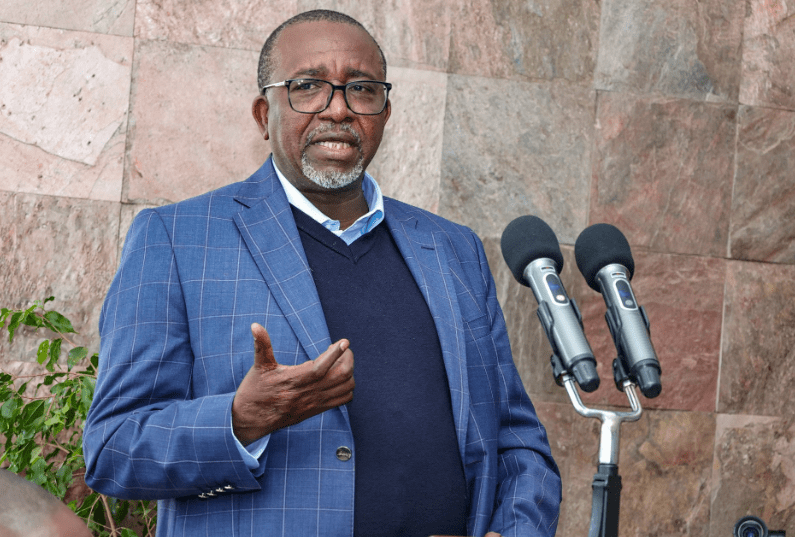
Former Trade CS and Chama Cha Kazi Party Leader Moses Kuria sparked debate on Saturday, 24 January 2026, with a post on X about economic ties between Somalia and Kenya.
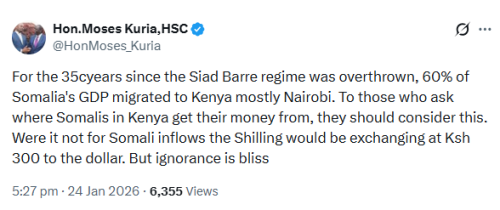
Kuria stated that for 35 years, since the Siad Barre regime fell, 60 per cent of Somalia’s GDP migrated to Kenya, mostly to Nairobi. Kuria defended Somalis in Kenya against queries about their wealth. He claimed these inflows stop the Kenyan shilling from hitting 300 to the dollar. The shilling now trades around Ksh129.
“For the 35 years since the Siad Barre regime was overthrown, 60% of Somalia’s GDP migrated to Kenya, mostly to Nairobi,” he stated.
“To those who ask where Somalis in Kenya get their money from, they should consider this. Were it not for Somali inflows, the shilling would be exchanging at Ksh 300 to the dollar. But ignorance is bliss.”
You Might Also Like


Siad Barre’s regime collapsed in 1991, triggering civil war in Somalia. Thousands fled to Kenya. Many settled in Nairobi’s Eastleigh neighbourhood. Somalis rebuilt their lives through trade and business.
They turned Eastleigh into a bustling hub for textiles, electronics and logistics. Somali entrepreneurs import goods from Dubai and China. They distribute these goods across East Africa.
Eastleigh boosts stability
In Eastleigh, multi-storey malls and hotels employ thousands. Remittances from Somalis abroad flow through Kenyan banks, adding billions.
Somali businesses transformed Eastleigh into a commercial powerhouse. This transformation attracts customers from across East Africa, boosting local economies. Their resilience during political unrest shows commitment to Kenya’s economy.
Critics sometimes argue that leaders from northern Kenya regions, including Somali-dominated areas, slow local growth by investing heavily in Nairobi instead of back home. Some point to posh hotels, malls and apartments in South C and Eastleigh as examples where funds go to urban luxury rather than schools, roads or farms in places like Mandera or Garissa.
Yet leaders from these areas push back strongly. Mandera South MP Abdul Haro defended the Somali community’s role on Tuesday, January 6, 2026. He said Kenyans working in Somalia send more than Ksh70 million home every day.
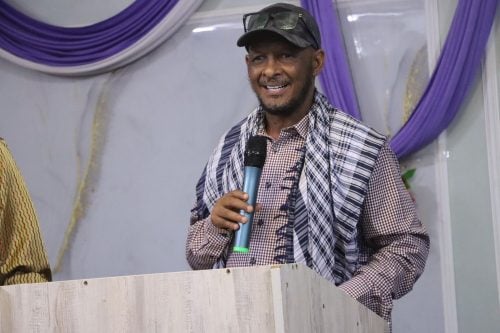
Haro claimed Somalis contribute almost 70 per cent of Kenya’s diaspora remittances, far beyond traditional sources like Europe or North America.
“And actually, if you talk of remittances, the other day the president told us actually the remittances from outside this country are becoming one of the major foreign income earners. And Somalis contribute almost 70 per cent of those remittances. Forget about the diaspora European countries,” he said.
Haro also described Eastleigh as one of Nairobi’s most active commercial centres. He claimed businesses there contribute about 30 per cent of Nairobi County’s tax revenue.
He criticised divisive talk from figures like former Deputy President Rigathi Gachagua, who questioned influence in Eastleigh. These inflows and investments support Kenya’s stability. Remittances hit over Ksh1 trillion by late 2025, per official figures. Somali-linked capital drives jobs, taxes and growth in Nairobi while linking economies across borders.
Author
Kenneth Mwenda
Kenneth Mwenda is a business, sports, and politics digital writer with over seven years of experience in journalism, covering breaking news, feature stories, and in-depth analysis across a range of beats.
For inquiries, he can be reached at [email protected]
View all posts by Kenneth MwendaLatest News







Advertisement
More on News