Advertisement
Ministerial meeting of the Group of Friends of the GDI
Wednesday 21st September, 2022 12:00 AM|
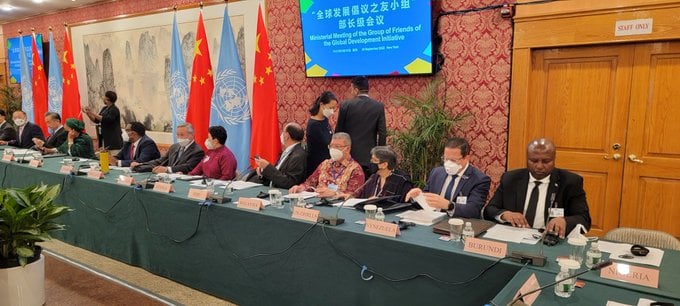
The Ministerial Meeting of the Global Development Initiative (GDI) was held under the theme “Deepen GDI Cooperation for Accelerated Implementation of the 2030 Agenda” in New York on September 20. The meeting was chaired by State Councilor and Foreign Minister Wang Yi of the People’s Republic of China, and attended by high-level representatives of 60 countries, including four deputy prime ministers and more than 30 foreign ministers as well as principals of about ten international organisations and United Nations entities.
The meeting reviewed the positive progress made since the GDI was proposed, particularly after the High-level Dialogue on Global Development held on June 24. The participants had an in-depth exchange of views on deepening practical cooperation in various priority areas of the GDI, accelerating the implementation of the 2030 Agenda for Sustainable Development and the achievement of the Sustainable Development Goals, promoting institutional arrangements of the Group, and strengthening cooperation with the UN development system aligned with national priorities and needs.
They discussed the way forward for GDI cooperation and reached broad consensus. In his statement, China’s State Councilor and Foreign Minister Wang Yi stressed that President Xi Jinping chaired the High-level Dialogue on Global Development in June, in which the participating leaders jointly put development front and centre again on the international agenda.
Wang Yi stressed that China stands ready to strengthen strategic alignment with all members of the Group of Friends of the GDI and all other parties, center on the implementation of the 2030 Agenda, work together with the UN development system, focus on concrete projects by making good use of the newly upgraded Global Development and South-South Cooperation Fund and the UN Peace and Development Trust Fund while pooling resources from all parties.
China will also continuously enrich and improve the GDI project pool, and carry out policy dialogue, experience sharing, capacity building and practical cooperation in the eight GDI priority areas. Wang Yi pointed out the need to work on institutional arrangements of the Group, and make good use of the public good and cooperation platforms provided by the GDI to better meet the development needs of different regions and countries in various special situations.
He expressed China’s appreciation for the active support of UN Secretary-General António Guterres for GDI, and encouraged the UN development agencies to participate in GDI cooperation as important partners, fostering synergy between their strategic plans and GDI cooperation, and carrying out cooperation in GDI priority areas to support the Group members in implementing the 2030 Agenda with international development resources including funds provided by China. Wang Yi stressed that as an open and inclusive partnership, GDI welcomes the participation of the developed countries in GDI projects to deliver on their ODA commitments.
The holistic GDI is a valued contribution in addressing the common challenges and accelerating the transition to our sustainable and inclusive future. UN Secretary-General urged all to work together to put the SDGs back on track for the well-being of this and future generations and the planet on which we all depend.
On behalf of the Chinese Government, Wang Yi presented to UN Deputy Secretary-General Amina Mohammed six global data products for sustainable development, focusing on food security, climate change and sustainable cities and communities, with a view to providing support for science-based decision-making in attaining relevant SDGs.
The participants expressed deep concern over issues such as the current state of food insecurity, the challenges to energy access, the consequences and socioeconomic impacts of the COVID-19 pandemic and the adverse impacts of climate change, desertification, biodiversity loss and pollution, as well as the negative impact of unilateral coercive measures that are not in accordance with international law and the UN Charter.
They expressed support for the Global Climate Fund and the Global Environment Facility to make more effective use of resources, and help developing countries make sustainable transitions and promote climate adaptation and mitigation for achieving sustainable development, based on the principles of equity and common but differentiated responsibilities and respective capabilities.
The Group noted that lack of energy access remained a challenge for developing countries and that sustainable and resilient development would be unachievable without universal access to affordable, reliable and sustainable energy. They encouraged the UN to engage with Member States in implementing SDG7 in a comprehensive and evidence-based manner.
The participants stressed the importance of promoting inclusive and sustainable industrialization and diversification of production for developing countries, and called for assistance to developing countries in formulating industrialization strategies suited to their national conditions and in line with national priorities.
They stressed the need to overcome the disruption of industrial and supply chains caused by the pandemic and geopolitical factors. They also committed themselves to strengthening regional and cross-regional economic integration and connectivity, especially through applying digital and big data technologies, enhancing digital empowerment, strengthening digital-era connectivity, building long-term scientific and cultural relations, stepping up knowledge sharing, and enhancing development policy exchanges and people-to-people exchanges.
The participants expressed full solidarity and support to the Government and people of the Islamic Republic of Pakistan on the massive scale of destruction and huge loss of life, property, infrastructure, livestock and livelihoods caused by unprecedented floods, triggered by heavy monsoon rains, reflecting the adverse impact of climate change.
They recognised the urgency of undertaking an extensive rescue and relief operation and support the Government of Pakistan’s efforts for relief, rehabilitation and reconstruction. They urged the international community, in particular donor countries, international financial institutions and relevant international organisations, as well as the private sector and civil society to extend full support and assistance to the Government of Pakistan in mobilising the necessary financial resources.
Author
PD columnist
View all posts by PD columnistLatest News





Advertisement
More on News