Martha Koome unveils sweeping justice reforms ahead of 2027 General Election
By Mustafa Juma, July 27, 2026Chief Justice Martha Koome has unveiled five major justice-sector reform instruments aimed at accelerating digital transformation, strengthening survivor-centred justice, and improving coordination across Kenya’s justice system as the country prepares for the 2027 General Election.
Taking to her official X account shortly after presiding over the 38th Meeting of the National Council on the Administration of Justice (NCAJ) on Monday, July 27, 2026, Koome said the reforms are designed to make justice more accessible, efficient and responsive to the needs of ordinary Kenyans while enhancing collaboration among institutions involved in the administration of justice.
The Chief Justice said the reforms reflect a shared commitment by justice sector institutions to strengthen public confidence in the rule of law through improved coordination and service delivery.
“The justice system is experienced by the public not as a collection of separate institutions, but as one interconnected justice chain,” Koome said.
“The effectiveness of investigation, prosecution, adjudication, legal aid, corrections, probation and rehabilitation is therefore deeply interconnected. A weakness in one part of the chain inevitably affects confidence in the entire system.”
Five landmark reforms
Among the reforms launched is the Justice Sector ICT Policy and Action Plan, which seeks to accelerate digital transformation across justice institutions by improving secure information sharing, institutional coordination, evidence-based decision-making and reducing reliance on paper-based systems.
Koome said the policy would support the Judiciary’s long-term ambition of building a more efficient, integrated and increasingly paperless justice system.
The Judiciary also launched new Standard Operating Procedures on Sexual and Gender-Based Violence (SGBV), aimed at strengthening survivor-centred and trauma-informed responses while reducing institutional gaps that often expose survivors to secondary victimisation.
Another key reform is the introduction of People-Centred Justice Guidelines, accompanied by a nationwide study that shifts the focus of justice delivery beyond case statistics to the actual experience of citizens seeking justice.
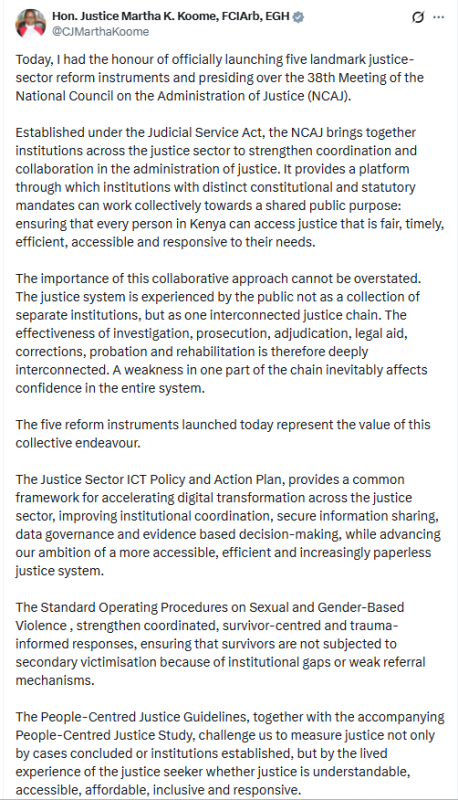
According to Koome, the guidelines encourage institutions to measure justice based on whether it is understandable, affordable, inclusive and responsive to the needs of the public.
The Judiciary further launched Standard Operating Procedures for Service Delivery Initiatives, intended to improve planning and coordination of justice outreach programmes across the country.
2027 election preparations
Koome said the reforms come at a critical time as justice institutions begin preparations for the 2027 General Election.
Over the next two days, the NCAJ will deliberate on a broad range of issues expected to shape Kenya’s justice sector ahead of the polls.
Among the agenda items are election preparedness, responses to sexual and gender-based violence and femicide, instant traffic fines, wildlife crime, identification parade procedures, child-friendly justice, legal aid, open prisons and recovery treatment courts.
The discussions are expected to produce coordinated policy recommendations involving multiple institutions responsible for delivering justice.
Strengthening institutional collaboration
Established under the Judicial Service Act, the National Council on the Administration of Justice brings together institutions across the justice sector, including the Judiciary, the Office of the Director of Public Prosecutions, the National Police Service, the Kenya Prisons Service, the Law Society of Kenya and other constitutional and statutory agencies.
Its primary role is to improve coordination among justice institutions while respecting the constitutional independence of each agency.
Koome said institutional independence and collaboration are complementary rather than competing principles.
“I have consistently maintained that institutional independence and collaboration are not competing values. Meaningful collaboration, grounded in mutual respect for constitutional and statutory mandates, is essential to strengthening the rule of law and delivering justice that serves the people,” she said.
Focus on the justice seeker
The Chief Justice said future justice reforms must ultimately be measured by their impact on ordinary Kenyans rather than the number of institutions created or cases concluded.
She noted that the real success of justice-sector reforms would depend on whether citizens experience a justice system that is fair, coherent, dignified and responsive regardless of their social or economic background.
“Our responsibility is to ensure that the justice chain works as one, while each institution remains faithful to its constitutional mandate,” Koome said.
She added that the Judiciary and its partners remain committed to deepening access to justice, strengthening public confidence in the rule of law and building a truly people-centred justice system as Kenya heads towards the 2027 elections.