Advertisement
Makau Mutua questions the value of public participation amid US health deal setback
Friday 12th December, 2025 06:14 PM|

Chairperson of President William Ruto’s Panel of Experts on Compensation of Victims of Demonstrations and Protests, Makau Mutua, has sparked debate after questioning the very foundation of public participation in democratic governance, just hours after the country marked Jamhuri Day celebrations at Nyayo Stadium.
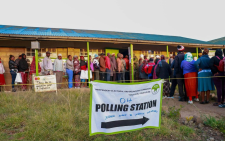
In a statement shared on X on Friday, December 12, 2025, Mutua challenged the widely held belief that public participation genuinely empowers citizens, arguing instead that it often serves the interests of elites rather than the public.
Mutua’s comments cut across legal, political, and philosophical lines, taking aim at how public participation is applied in practice rather than how it is framed in theory. He suggested that the concept has become a convenient tool, selectively used to legitimise decisions already made by those in power.
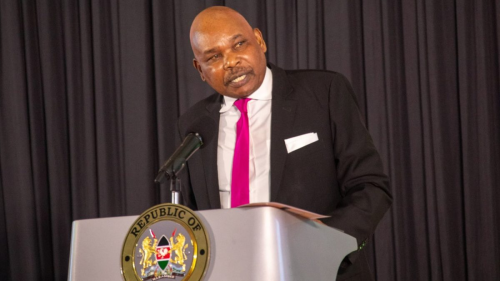
“In a democracy, public participation is a charade often used by courts to strike out government policies they don’t like, or oppose a President they loathe,” Mutua said.
You Might Also Like

He went further to argue that the idea itself is deeply flawed, tracing its roots to political theory and questioning its real-world usefulness.
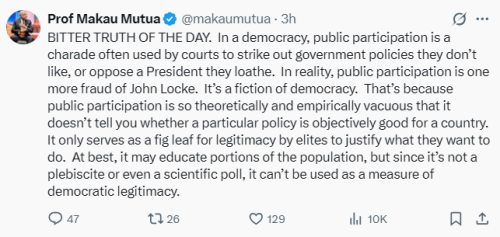
“In reality, public participation is one more fraud of John Locke. It’s a fiction of democracy,” he stated.
Does it improve governance
According to Mutua, the problem lies in the absence of objective standards to measure whether public participation actually improves governance or policy outcomes. He argued that simply collecting views from the public does not automatically lead to better or more legitimate decisions.
“That’s because public participation is so theoretically and empirically vacuous that it doesn’t tell you whether a particular policy is objectively good for a country,” he said.
Mutua also warned that the process often becomes symbolic, offering the appearance of inclusion while masking elite decision-making.
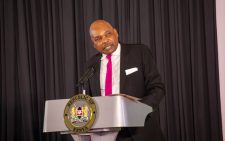
“It only serves as a fig leaf for legitimacy by elites to justify what they want to do,” he added.
While acknowledging that public engagement can have some value, Mutua insisted that its limitations are rarely discussed honestly in democratic spaces.
“At best, it may educate portions of the population, but since it’s not a plebiscite or even a scientific poll, it can’t be used as a measure of democratic legitimacy,” he argued.
US-Kenya health deal
The High Court on Wednesday, December 10, 2025, issued conservatory orders suspending the multi-billion-shilling health corporation agreement signed between Kenya and the US.
“Pending the hearing and determination of the petition, a conservatory order is hereby issued restraining the respondents from implementing the health framework executed on or about 4 December 2025,” the court directed.
The decision came despite President William Ruto allaying fears that Kenya would be shortchanged in the deal.
Author
Latest News




Advertisement
More on News