Advertisement
US restricts travellers from Uganda, DRC over Ebola outbreak concerns
Thursday 16th July, 2026 11:58 AM|

The United States has introduced new travel restrictions for people arriving from Uganda, the Democratic Republic of Congo (DRC), and South Sudan as health authorities respond to an ongoing Ebola outbreak in parts of East and Central Africa.
The US Centers for Disease Control and Prevention (CDC) said on July 14, 2026, that it is working with the Department of Homeland Security (DHS) to prevent Ebola disease from entering the country.
The measures include restricting entry for travellers who were recently in the DRC and certain travellers who were recently in Uganda or South Sudan.
The CDC said travellers who have visited affected countries must monitor themselves for Ebola symptoms for 21 days after leaving those areas.
You Might Also Like

“Anyone who develops symptoms should avoid travel and contact public health authorities immediately,” the CDC said in its latest guidance issued on July 14, 2026.
The announcement comes as the US continues to respond to an Ebola outbreak involving the Democratic Republic of Congo and Uganda, with health officials warning that the full scale of the outbreak remains unclear.
US introduces entry restrictions
Under the new measures, the CDC and DHS have established a “Do Not Board” process targeting travellers departing from the DRC.
American citizens leaving the DRC may be affected by the restriction and may only return to the United States after spending 21 days outside the country.
The US government said the restrictions are aimed at reducing the risk of Ebola cases being imported into the country.
On July 13, 2026, authorities issued an order extending the suspension of entry for certain foreign nationals from countries affected by quarantinable diseases. The order will remain active for 30 days.
The CDC said travellers from Uganda and South Sudan who are permitted to enter the US will be redirected to designated airports for health screening.
The four airports handling the screening are Washington-Dulles International Airport in Virginia, Hartsfield-Jackson Atlanta International Airport in Georgia, George Bush Intercontinental Airport in Houston, and John F. Kennedy International Airport in New York.
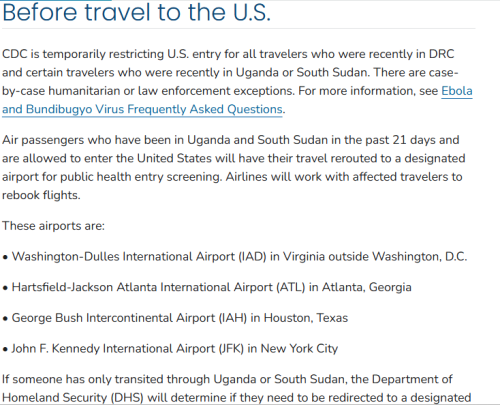
Airlines will assist affected travellers with changing their travel arrangements.
Travellers arriving from Uganda and South Sudan will undergo public health screening before continuing with their journeys.
The screening process includes completing a questionnaire about travel history and possible symptoms, temperature checks using non-contact thermometers, and observation by CDC health officials.
Some travellers may also receive additional assessments depending on their exposure risk.
The CDC said travellers without symptoms will receive guidance on monitoring their health for 21 days after leaving an affected country.
“Most travellers without symptoms will continue to their final destination after public health entry screening,” the agency said.
However, passengers who show signs linked to Ebola disease will undergo further evaluation.
Health officials may transfer travellers with suspected Ebola infections to medical facilities for isolation, assessment, and treatment.
US warns against travel to Uganda, DRC
The travel restrictions come after the US Department of State placed Uganda and the DRC under a Level 4 “Do Not Travel” advisory.
The advisory, issued on July 15, warned Americans against visiting the two countries because of security concerns and the government’s limited ability to provide assistance.
“We issue Travel Advisories with Levels 1-4. Level 4 means Do Not Travel. We assign Level 4 based on local conditions and/or our limited ability to help Americans there,” the State Department said.
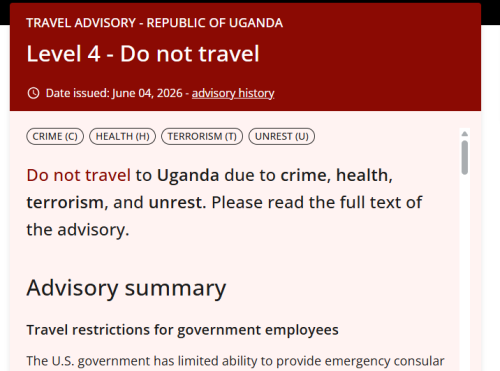
South Sudan, which shares borders with Uganda and the DRC, was also placed under the highest travel warning.
The advisory also included other countries in the region, including Somalia and Sudan. Kenya was not included among the countries placed under the Level 4 warning.
The restrictions have raised concerns among humanitarian organisations involved in Ebola response efforts.
Reuters reported that some aid groups fear the measures could affect the movement of American health workers supporting Ebola containment activities in affected areas.
Ebola symptoms travellers should watch
The CDC has advised people who have travelled from affected countries to monitor their health closely for 21 days.
For travellers from the DRC and Uganda, the agency recommends checking their temperature daily and seeking medical advice if they feel unwell.
The main Ebola symptoms include fever, headache, body aches, weakness, tiredness, sore throat, rash, diarrhoea, vomiting, stomach pain, and unexplained bleeding or bruising.
The CDC advised travellers who develop symptoms to avoid moving between locations and contact health authorities immediately.
“Do not travel while sick. Travel only when you have been cleared by a doctor or health official,” the agency said.
Health authorities say early reporting is important because it allows medical teams to respond quickly and reduce the risk of further infections.
The travel measures follow growing concern over Ebola cases reported in the Democratic Republic of Congo.
The outbreak has been linked to the Bundibugyo strain of Ebola virus, according to health officials.
The World Health Organisation (WHO) has reported that the DRC outbreak has recorded more than 1,900 confirmed cases and over 700 deaths, making it one of the largest Ebola outbreaks recorded.
Uganda has also increased surveillance and response measures as authorities monitor cases and possible spread.
Ebola is a severe viral disease that can spread through direct contact with infected body fluids. Health officials say early detection, isolation, and medical support remain key measures in controlling outbreaks.
The CDC has urged travellers, airlines, and health authorities to follow official guidance as investigations into the outbreaks continue.
Author
Kenneth Mwenda
Kenneth Mwenda is a business, sports, and politics digital writer with over seven years of experience in journalism, covering breaking news, feature stories, and in-depth analysis across a range of beats.
For inquiries, he can be reached at [email protected]
View all posts by Kenneth MwendaLatest News





Advertisement
More on News