Advertisement
Why Kenya’s rich are prioritising cash flow over capital gains – report
Thursday 16th July, 2026 10:50 AM|

Kenya’s wealthy investors are increasingly shifting away from speculative bets and capital appreciation plays in favour of assets that generate steady income, signalling a major change in wealth management strategies amid economic uncertainty.
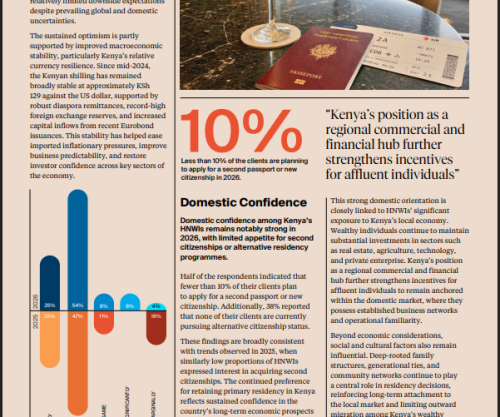
According to Knight Frank Kenya’s Wealth & Investment Trends 2026 report, high-net-worth individuals (HNWIs) are increasingly directing capital towards income-generating assets such as data centres, purpose-built rental housing, logistics facilities, fixed-income investments and student accommodation.
The trend suggests that for many wealthy investors, predictable cash flow is becoming more important than the prospect of large capital gains.
“Kenyan HNWIs continue to prioritise investments with stronger income-generating potential, long-term capital appreciation and wealth-preservation characteristics,” the report says.
You Might Also Like



The shift comes as investors navigate a changing economic landscape marked by higher borrowing costs, currency volatility, inflationary pressures and evolving real estate dynamics.
For years, wealth creation in Kenya was heavily associated with buying land and holding property in anticipation of future price appreciation. However, the latest Knight Frank findings indicate that investors are becoming more selective, focusing on assets capable of generating regular returns regardless of market cycles.
The report identified growing interest in alternative real estate segments, including data centres, logistics assets, purpose-built rental housing and student accommodation, sectors that derive value primarily from recurring income streams rather than speculative price growth.
“Investors are increasingly asking how much an asset earns rather than simply how much it might be worth in the future,” the report reads.
Real estate
The preference for cash flow is also evident in declining enthusiasm for some traditional real estate sectors. The report found that investors are reassessing exposure to conventional office and retail property, which have faced pressure from changing work patterns, oversupply concerns and shifting consumer behaviour.
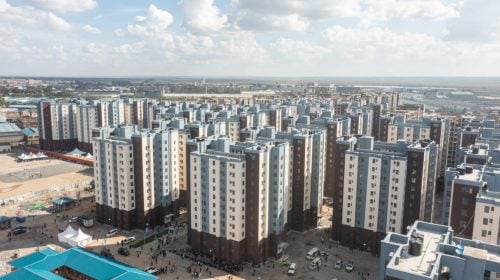
Instead, assets linked to long-term demand trends are attracting attention. Data centres, for example, benefit from the rapid growth of cloud computing, artificial intelligence, fintech and digital services. Rental housing is supported by urbanisation and housing demand, while logistics facilities continue to gain from e-commerce growth and supply-chain expansion.
Knight Frank’s findings suggest that wealthy investors are increasingly viewing these assets as businesses that generate recurring revenue rather than simply property holdings.
Global trends
Globally, institutional investors have increasingly shifted capital into infrastructure, rental housing, logistics and digital assets in pursuit of stable yields. Kenyan millionaires appear to be adopting a similar approach as they seek to preserve and grow wealth over the long term.
The report also indicates that wealth preservation is becoming a central investment objective. Rather than pursuing high-risk opportunities, investors are focusing on diversification and resilience.
This helps explain growing allocations to fixed-income investments, which provide predictable returns and lower volatility compared to many growth-oriented assets.
The findings point to a broader transformation in how wealth is being managed.
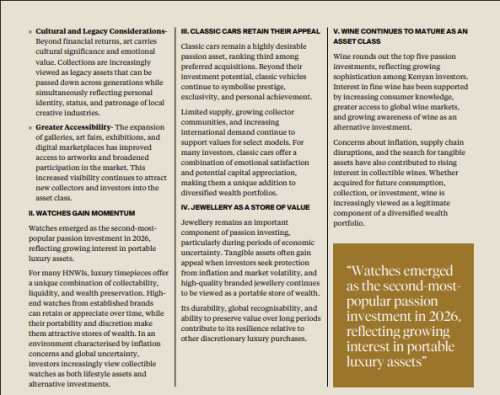
Historically, affluent investors often prioritised capital appreciation through land banking and speculative real estate acquisitions. Today, the emphasis is increasingly on generating sustainable income while protecting wealth across generations.
Knight Frank notes that investors remain focused on preserving and growing wealth over the long term, with many favouring assets capable of delivering both income and defensive characteristics.
The shift could have significant implications for Kenya’s investment landscape. Developers may increasingly focus on rental housing, logistics parks and digital infrastructure projects that align with investor demand. Asset managers could see greater interest in income-focused products, while policymakers may need to support sectors attracting long-term capital.
As the Knight Frank report suggests, the future of wealth creation may no longer be defined by buying assets and waiting for prices to rise. Instead, it may depend on owning assets that generate income consistently, year after year.
Author
Latest News







Advertisement
More on Business