Ledama Olekina questions national unity amid tribal politics claim
By Faith Lagat, January 15, 2026Narok Senator Ledama Olekina has sparked renewed debate on Kenya’s persistent tribal divisions with a pointed X post questioning the viability of national unity in a political system dominated by ethnic calculations.
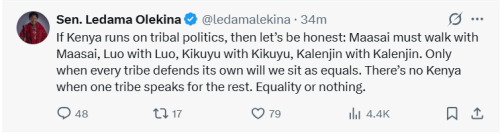
In the post dated January 15, 2026, Olekina argued that genuine equality cannot exist where one community is perceived to speak or decide for others.
He stated, “If Kenya runs on tribal politics, then let’s be honest: Maasai must walk with Maasai, Luo with Luo, Kikuyu with Kikuyu, and Kalenjin with Kalenjin. Only when every tribe defends its own will we sit as equals. There’s no Kenya when one tribe speaks for the rest. Equality or nothing.”
Education equity at the centre
Olekina’s comments come amid an intensifying national debate on education equity, triggered in part by former Deputy President Rigathi Gachagua’s recent criticism of national school admissions.
Gachagua has claimed that students from the Mount Kenya region are disadvantaged in placements to elite national schools located within the region, despite strong academic performance.
He argued that communities which invest heavily in school infrastructure, including laboratories and dormitories, should not see local students miss out on placements in favour of learners from other regions with lower marks.
At the same time, Gachagua maintained that his position is rooted in merit and fairness, insisting that “all learners who excel academically must be placed in national schools purely on merit.”
Olekina has previously weighed in on the same issue. Following the release of the 2025 KCSE results on January 9, 2026, he criticised the national schools model, describing it as outdated and divisive.
He said, “The truth is, Kenya’s obsession with ‘top schools’ is misplaced. Our glorified national schools are a relic that fuels elitism, tribalism, and inequality.”
Political reactions and wider context
The senator further argued that focusing on a few elite institutions masks systemic failures in underfunded schools across rural and marginalised areas. He noted that while competition for schools such as Alliance and Mang’u remains intense, many learners remain in institutions that lack basic resources.
The debate has also drawn in other political leaders. Interior Cabinet Secretary Kipchumba Murkomen recently criticised Gachagua for viewing national issues through what he termed a tribal lens, saying the former deputy president approaches matters such as education and the fight against drugs from a “parochial, tribal angle”.