Advertisement
Koome: Courts must guard against power imbalances in carbon offsetting
Tuesday 05th August, 2025 04:02 PM|

Chief Justice Martha Koome has urged the Kenyan judiciary to adopt a proactive and inclusive approach in handling disputes arising from carbon offsetting projects.
Her remarks come amid growing global scrutiny of the carbon credit market and its potential to disadvantage local communities, especially in Africa.
Speaking during a judicial training session for Environment and Land Court (ELC) judges on carbon offsetting and land rights on Tuesday, August 5, 2025, Koome said the courts must remain alert to the unequal power dynamics that often exist between multinational corporations and Indigenous or rural populations.
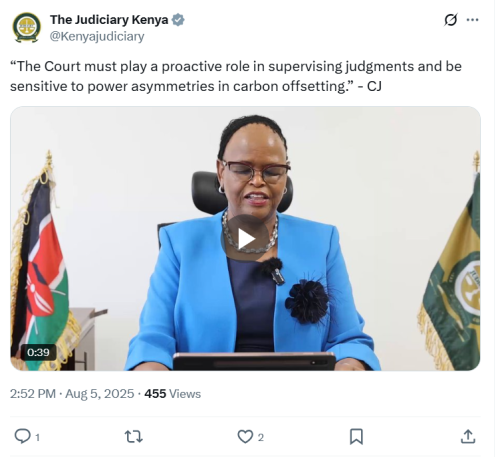
“The Court must play a proactive role in supervising judgements and be sensitive to power asymmetries in carbon offsetting,” read part of the Judiciary X post, adding that judicial vigilance is essential to prevent the deepening of inequalities under the guise of climate action.
Safeguarding community interests
You Might Also Like



Carbon offsetting schemes, commonly touted as solutions to reduce global emissions, have increasingly come under fire for marginalising communities living near forests and other conservation sites. Many of these communities lack the resources or legal knowledge to negotiate fair terms or seek redress when projects infringe on their land or livelihoods.
Koome emphasised the role of the courts in ensuring land and carbon rights are protected, benefits are shared equitably, and local voices are heard in the implementation of carbon projects. “The Court must remain vigilant on land and carbon rights, fair benefit-sharing, impact monitoring, and protection of communities,” she noted.
Expanding access to justice
As part of her broader vision for judicial reform, Koome also called for the adoption of a multi-door approach to justice. She advocated for mechanisms such as arbitration, mediation, and Alternative Justice Systems (AJS) to resolve disputes in a more accessible, cost-effective, and culturally responsive manner.
“Arbitration, mediation, and AJS provide responsive, flexible, and cost-effective means of dispute resolution,” she said. According to the Chief Justice, integrating these mechanisms is particularly important in climate-related cases, where affected communities may be far removed from the formal court system.
Judicial responsibility in climate governance
Koome’s remarks reflect a shifting judicial philosophy that recognises climate change not only as an environmental issue but also as a question of rights and equity. By urging courts to engage more deeply in post-judgment oversight and be mindful of ground-level realities, she is positioning Kenya’s judiciary as a vital player in the just transition towards sustainable development.
Author
Latest News








Advertisement
More on News