Advertisement
KNCHR initiates compensation process to victims of human rights violations
Friday 13th March, 2026 06:35 PM|

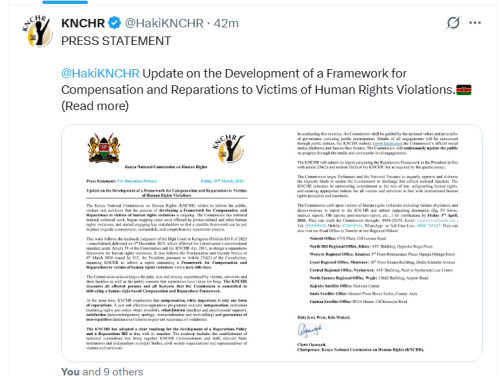
The Kenya National Commission on Human Rights (KNCHR) has provided an update on its ongoing work to develop a Framework for Compensation and Reparations for victims of human rights violations.
The commission urged Parliament and the National Treasury to fast-track funding to support this vital work.
Victims, especially from the 2024 Gen Z-led protests, where KNCHR documented around 60 deaths, over 600 injuries, abductions, and other abuses, are urged to submit claims with supporting evidence, such as medical reports, IPOA findings, or post-mortem documents, by Friday, April 3, 2026.
“The Commission calls upon victims of human rights violations, including victims of protests and demonstrations, to report to the KNCHR and submit supporting documents (e.g. medical reports, IPOA reports, post-mortem reports, etc.) for verification by Friday, 3rd April, 2026,” read the X post dated March 13, 2026, in part.
You Might Also Like
Claims can be submitted via SMS (22359), telephone (0722 669 000 / 0726 610 159), email ([email protected]), WhatsApp, toll-free line (0800 627…), or in person at the Nairobi Head Office or regional offices in Kitale, Kisumu, Mombasa, Nyahururu, Garissa, Kajiado, Isiolo, Kitui, and other locations.
The initiative represents a key step toward justice and accountability, offering victims a pathway to healing and meaningful redress for one of Kenya’s most turbulent periods of civic unrest.
Ruto settling on KNCHR for compensation
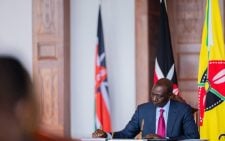
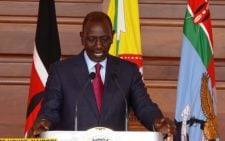
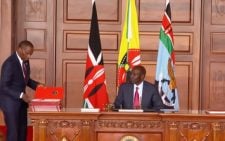
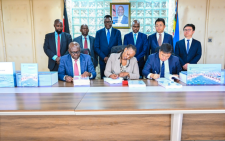
This development comes days after President William Ruto directed the Kenya National Commission on Human Rights (KNCHR) to prepare and submit a detailed framework for compensation and reparations within 60 days.
The directive, issued through a presidential proclamation dated February 5, 2026, and gazetted on March 6, 2026, invoked Articles 131(2)(e) and 254(2) of the Constitution, acknowledging the government’s responsibility to protect human rights and addressing violence during protests that led to loss of life and serious injuries.
The move follows a landmark High Court ruling on December 4, 2025, in Kerugoya (consolidated petitions including E010 of 2025), where Justice Edward Muriithi declared unconstitutional the previous establishment of an 18-member Panel of Experts, chaired by Prof. Makau Mutua, to handle protest victim compensation.
The court confirmed that such matters fall under KNCHR’s exclusive mandate under Article 59(1)(g) of the Constitution and the KNCHR Act, 2011.
Holistic approach to reparations
In the press statement, KNCHR Chairperson Claris Ogwang acknowledged the profound pain, loss, and anxiety endured by victims, survivors, and their families, as well as public frustration over delays.
She emphasised that reparations go beyond financial compensation and include restitution, rehabilitation through medical and psychosocial support, satisfaction through acknowledgements or apologies, memorialisation via truth-telling, and guarantees of non-repetition through institutional reforms.
KNCHR has launched technical work, mapped high-impact areas affected by protest-related violations, and formed multi-stakeholder committees involving staff, state bodies, civil society, and victim representatives.
The roadmap includes drafting a Reparations Policy and Bill guided by public participation through notices, the KNCHR website, social media, media updates, and community forums.
This comes even as President William Ruto confirmed the allocation of Ksh2 billion towards the compensation process.
Author
Latest News

Advertisement
More on News