Advertisement
Kivutha Kibwana reflects on Kenya’s historical milestones, questions future after 2027
Saturday 13th September, 2025 12:37 PM|

Former Makueni Governor and constitutional scholar Kivutha Kibwana has sparked discussion on Kenya’s political journey and its future prospects with a reflective post on X.
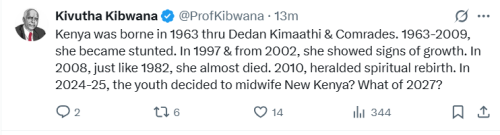
In a post dated September 13, 2025, Kibwana wrote, “Kenya was born in 1963 through Dedan Kimathi & Comrades. From 1963 to 2009, she became stunted. In 1997 & from 2002, she showed signs of growth.”
In 2008, just like in 1982, she almost died. 2010 heralded spiritual rebirth. In 2024-25, the youth decided to midwife New Kenya? What of 2027?”
The post traces Kenya’s turbulent history while raising questions about the country’s trajectory ahead of the 2027 elections.
You Might Also Like



Also watch: Kivutha Kibwana: I wish that in 2027, we won’t do tribal politics.
Kibwana’s overview begins with the Mau Mau Uprising led by Dedan Kimathi, which paved the way for Kenya’s independence in 1963.
He described the decades that followed as periods of stagnation until signs of growth emerged in 1997 and 2002, only to be disrupted by near collapses in 1982 and 2008, which were marked by political unrest and economic challenges.
He identified the adoption of the 2010 Constitution as a “spiritual rebirth”, a view reinforced during its 15th anniversary celebrations at the Kenyatta International Convention Centre, where President William Ruto hailed it as a transformative charter.
Political questions
Kibwana highlighted youth-led protests against the Finance Bill in 2024-25, framing them as a potential “midwifery” for a New Kenya.
His post also posed a critical question about the upcoming 2027 elections, signalling uncertainty amid heightened political realignments and governance debates.
Speaking on a local radio station in August, he identified the executive and legislature as “the weakest links” in constitutional implementation, echoing concerns over impunity and the rule of law.
Civic reflection
Kibwana’s reflections align with his recent support for President Ruto’s proclamation of August 27 as Katiba Day to commemorate the 2010 Constitution.
He described the decision as “surprising and significant”, noting, “There is also a positivity about it because it means that the president has given a signal that the constitution is important to the public.”
Also watch: Kivutha Kibwana says Kalonzo is playing his cards close to his chest.
However, he emphasised that symbolic gestures must translate into action, urging full implementation of constitutional provisions.
Jubilee Party Secretary General Jeremiah Kioni also noted on August 27 that the constitution serves as a “lifeline” in governance, while underlining the underutilisation of independent commissions such as the IEBC and EACC.
Author
Latest News







Advertisement
More on News