KHRC blames state-backed goons for rising political violence
By Kenneth Mwenda, April 12, 2026The Kenya Human Rights Commission (KHRC) has accused what it calls ‘state-backed goons’ of carrying out a coordinated wave of violence targeting political meetings, voter registration exercises, and public officials across several parts of the country.
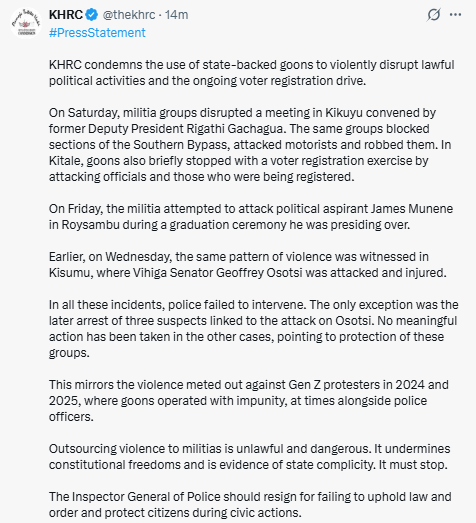
In a statement posted on Sunday, April 12, 2026, KHRC said militia groups have increasingly been used to disrupt lawful political activities, warning that the trend threatens constitutional rights and public safety.
The rights group pointed to incidents in Kikuyu, Kitale, Roysambu, and Kisumu as part of what it described as a growing pattern of organised attacks.
On Saturday, KHRC said groups of armed youths disrupted a political meeting in Kikuyu linked to former Deputy President Rigathi Gachagua. The groups also blocked sections of the Southern Bypass, attacked motorists, and robbed them before dispersing.
KHRC also cited an incident in Kitale where voter registration activities were briefly halted after officials and members of the public came under attack. In Roysambu, the commission said unknown groups attempted to disrupt a graduation ceremony presided over by political aspirant James Munene.
Earlier in the week, KHRC said similar violence was witnessed in Kisumu where Vihiga Senator Geoffrey Osotsi was attacked and injured. The incident has already triggered separate political and public debate, with Osotsi previously giving a detailed account of how he was assaulted at a Kisumu business complex.
Police face mounting criticism
KHRC said police failed to intervene effectively in most of the incidents. It only acknowledged arrests linked to the Kisumu case, saying no meaningful action had been taken in other reported attacks.
“In all these incidents, police failed to intervene. The only exception was the later arrest of three suspects linked to the attack on Osotsi,” the commission said. “No meaningful action has been taken in the other cases, pointing to the protection of these groups.”
The organisation linked the recent events to past election-related violence, saying the pattern resembled attacks witnessed during Gen Z protests in 2024 and 2025, where it claimed armed groups operated with impunity.
KHRC warned that the continued use of militias undermines democratic freedoms and could deepen political instability. It also accused authorities of complicity, saying the state risks normalising violence in civic and political spaces.
“Outsourcing violence to militias is unlawful and dangerous. It undermines constitutional freedoms and is evidence of state complicity. It must stop,” the statement read.
The commission went further to call for accountability at the highest levels of security leadership, urging the Inspector General of Police to resign over what it termed failure to protect citizens during civic activities.
The National Police Service has not yet responded to the allegations.
Political leaders mentioned in the incidents have also not issued direct responses to KHRC’s claims. Meanwhile, tensions remain high in several regions as investigations into the reported attacks continue.