Kenyans in Saudi Arabia get pay boost under new wage rules
By Kenneth Mwenda, November 16, 2025Kenyans working in Saudi Arabia are set for a salary boost after the Saudi government announced a new minimum wage for all workers. The policy will take effect in February 2026 and will set the lowest monthly pay at 1,000 Saudi Riyals, which is roughly Ksh34,455.
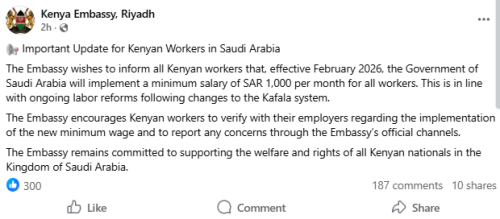
The Kenyan Embassy in Riyadh released the update via Facebook on Sunday, November 16, 2025, urging all Kenyan workers in the Kingdom to confirm the implementation with their employers. The embassy said the move follows ongoing labour reforms in Saudi Arabia after changes to the Kafala system.
In its statement, the embassy asked workers to monitor the transition closely and to report any cases of non-compliance through official channels. It also assured Kenyans that it remains committed to protecting their rights and welfare as the new policy rolls out.
“The Embassy wishes to inform all Kenyan workers that, effective February 2026, the Government of Saudi Arabia will implement a minimum salary of SAR 1,000 per month for all workers. This is in line with ongoing labour reforms following changes to the Kafala system,” the Facebook post read.
“The Embassy encourages Kenyan workers to verify with their employers regarding the implementation of the new minimum wage and to report any concerns through the Embassy’s official channels.”
“The Embassy remains committed to supporting the welfare and rights of all Kenyan nationals in the Kingdom of Saudi Arabia.”
The announcement comes at a time when concerns about the treatment of Kenyan workers abroad are growing. This follows a New York Times investigation that revealed widespread abuse of migrant workers, especially in Saudi Arabia.
The report highlighted cases of violence, forced confinement, and unexplained deaths involving Kenyan domestic workers. The investigation also showed that some agencies are linked to current and former officials, raising questions about conflicts of interest.
Prime Cabinet Secretary Musalia Mudavadi cautioned that criminal networks are targeting Kenyans with fake overseas job offers. He revealed that some Kenyans had been recruited into the Russian military under false pretences, while others were trafficked to Southeast Asia and forced into cybercrime operations.
Mudavadi said many victims fall for online adverts promising high pay and easy travel. He explained that some Kenyans travel abroad on tourist visas after being promised legitimate jobs, only to find themselves in forced labour or illegal activities. In one case, authorities rescued 21 Kenyans from a house in Athi River where they were being prepared for fake deployments.
DNA rules trap mothers
At the same time, Kiambu Senator Karungo Wa Thang’wa raised the alarm over Kenyan mothers stranded in Saudi Arabia due to strict DNA rules. He said some mothers who gave birth out of wedlock cannot return home with their children until they undergo DNA tests, a process that has dragged on for years without results. He shared the case of a woman from Vihiga who has been homeless in Riyadh with her eight-year-old daughter.
These reports underline the difficult conditions some Kenyan workers face abroad, even as many depend on the jobs for survival. The new minimum wage in Saudi Arabia is expected to lift earnings for thousands of Kenyans, especially domestic workers who previously had no official wage protection.
The embassy has urged all workers to stay alert, follow legal procedures and report any exploitation. It also encouraged job seekers in Kenya to use accredited recruitment agencies and to avoid online offers that appear suspicious or promise unusually high pay.